Nature Ecology & Evolution · 2026

Marine protected areas marginally offset anthropogenic declines in tropical reef fish contributions to nature and people

Flandrin U., Mouquet N., Loiseau N., Hautecoeur C., Maire E., McLean M., Sanchez L., Clausius E., Stuart-Smith R., Edgar G., Albouy C., Cinner J.E., Mouillot D.

doi.org/10.1038/s41559-026-03008-2
Download PDF
Scroll down for preview

Key Message

Human activities are rapidly eroding the biodiversity of most ecosystems, threatening the myriad contributions they provide to nature and people. Protected areas are often seen as key management tools for their conservation. However, the lack of historical baselines hinders our ability to fully assess these declines and the extent to which protected areas can compensate for decades of human-mediated degradation.

Using a Bayesian framework, we modelled 22 fish community contributions across 2,800 tropical reefs and predicted their levels under counterfactual scenarios to compare the relative benefits of marine protected areas (MPAs) and anthropogenic impacts on unprotected reefs. We show that human activities have significantly reduced fish biodiversity- and biomass-related contributions with, for example, a 120% decline in piscivore biomass, corresponding to a net loss of 19 kg per hectare of reef. In contrast, the benefits of MPAs appear comparatively low, with conservation efforts potentially offsetting only 5% of this decline.

Ultimately, only old and fully protected areas provide marked benefits to nature and people. This suggests that even if we drastically increase our protection efforts across the ocean (30% coverage by 2030), we cannot expect short-term socio-ecological benefits to counterbalance a long history of human footprint. A desirable future for nature and people thus requires a paradigm shift in our relationship with ecosystems and their biodiversity, beyond MPA establishment.
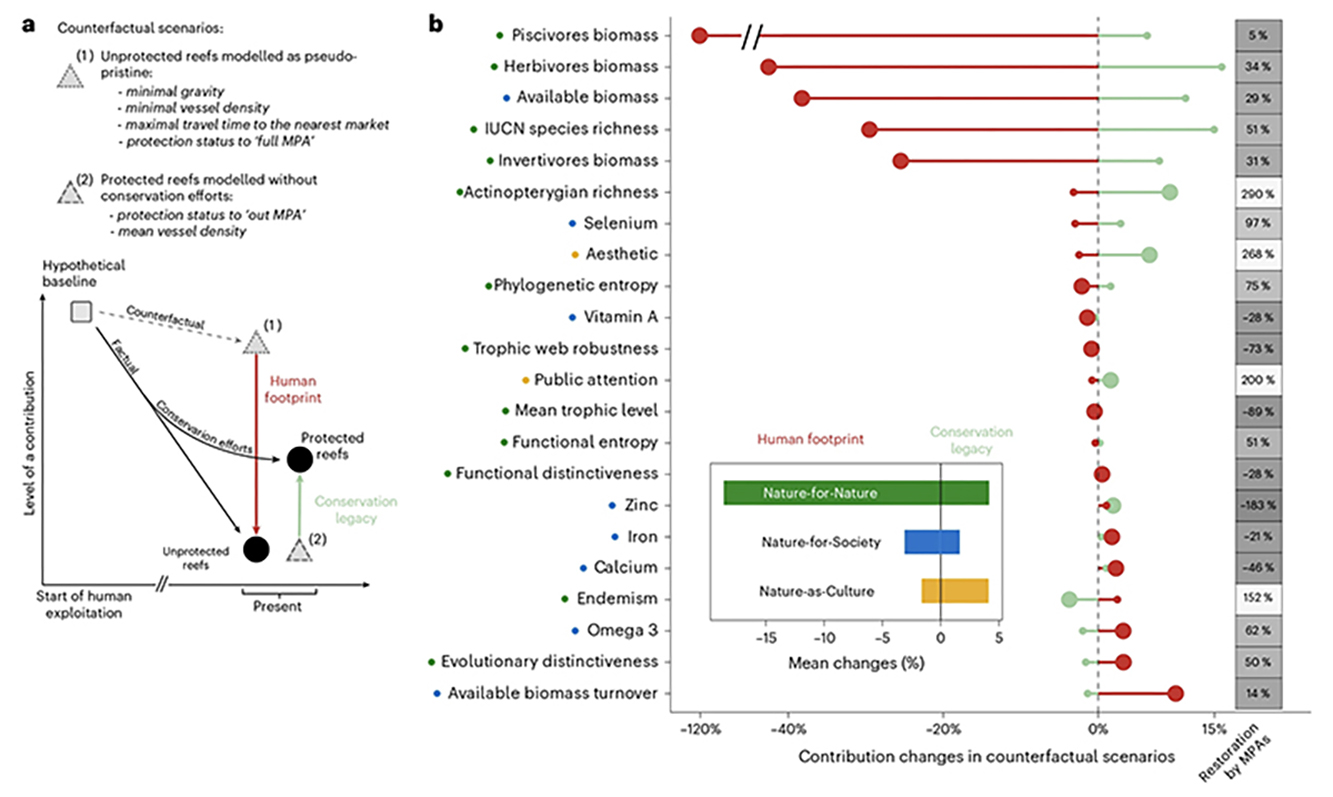
Conceptual framework representing counterfactual scenarios. Currently unprotected reefs were modelled under pseudopristine conditions, characterized by low human gravity, low vessel density, high travel time to the nearest human population and full protection. Conversely, reefs currently under full protection were modelled as unprotected (outside MPAs) and subject to the same vessel density as unprotected reefs of their country. The differences between these counterfactuals and the current situations were considered respectively as human footprint and conservation legacy. The magnitude of conservation legacy in relation to human footprint illustrates the potential of MPAs to bend the curve of fish contribution losses. b, Median percentages of changes in reef contributions for both counterfactual scenarios. In each reef and for each contribution, the percentage of change was calculated as the difference between the modelled contribution under current and counterfactual conditions, divided by the modelled contribution under current conditions. For a given contribution, a larger dark-red dot means that the loss due to human footprint is significantly greater than the gain from conservation legacy or vice versa for larger light-green dots.
Full Article (PDF)