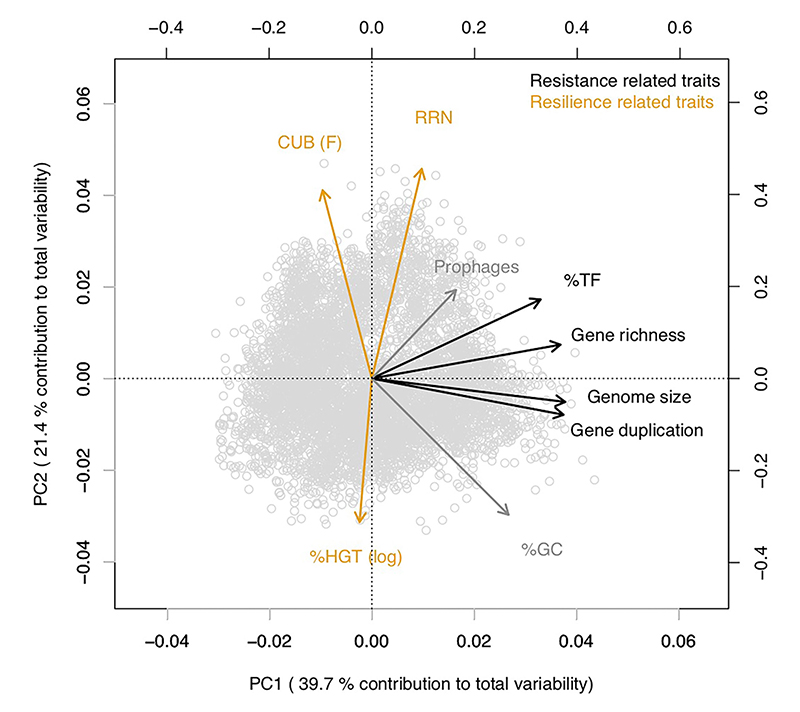
We report genomic traits linked to prokaryote life history and address conflicting trait correlation findings by examining trait-trait variation across 11 genomic traits from ~18,000 genomes.
We find two largely orthogonal resistance and resilience axes, with resilience overlapping an oligotrophic-copiotrophic axis in free-living taxa with large effective population sizes. Resistance and resilience traits were positively related below ~5 Mbp genomes but negatively related above this threshold, indicating habitat-dependent tradeoffs, since genome size distributions differ across habitats, which may explain conflicting reports and preclude a globally consistent mapping onto the competitor-stress-tolerator-ruderal (CSR) framework.
All traits showed significant phylogenetic signal, supporting use of this trait table to extrapolate genomic traits from marker genes and empirically test community assembly under the proposed resistance-resilience framework.