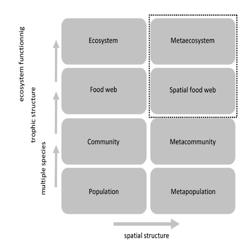
Modelling Approaches
Gounand I., Mouquet N., Canard E., Guichard F., Hauzy C., Gravel D. (2014). The Paradox of Enrichment in Metaecosystems. The American Naturalist, doi.org/10.1086/678406
Hauzy C., Nadin G., Canard E., Gounand I., Mouquet N., Ebenman B. (2013). Confronting the Paradox of Enrichment to the Metacommunity Perspective. PLoS ONE, doi.org/10.1371/journal.pone.0082969
Mouquet N., Gravel D., Massol F., Calcagno V. (2012). Extending the concept of keystone species to communities and ecosystems. Ecology Letters, doi.org/10.1111/ele.12014
Calcagno V., Massol F., Mouquet N., Jarne P., David P. (2011). Constraints on food chain length arising from regional metacommunity dynamics. Proceedings of the Royal Society B Biological Sciences, doi.org/10.1098/rspb.2011.0112
Gravel D., Mouquet N., Loreau M., Guichard F. (2010). Patch Dynamics, Persistence, and Species Coexistence in Metaecosystems. The American Naturalist, doi.org/10.1086/655426
Gravel D., Guichard F., Loreau M., Mouquet N. (2010). Source and sink dynamics in meta-ecosystems. Ecology, doi.org/10.1890/09-0843.1
Integrative Approaches & Reviews
Warren B.H., Ricklefs R.E., Thebaud C., Gravel D., Mouquet N. (2019). How Consideration of Islands Has Inspired Mainstream Ecology: Links Between the Theory of Island Biogeography and Some Other Key Theories. Elsevier eBooks, doi.org/10.1016/B978-0-12-409548-9.11788-9
Massol F., Altermatt F., Gounand I., Gravel D., Leibold M.A., Mouquet N. (2016). How life-history traits affect ecosystem properties: effects of dispersal in meta-ecosystems. Oikos, doi.org/10.1111/oik.03893
Loreau M., Daufresne T., Gonzalez A., Gravel D., Guichard F., Leroux S., Loeuille N., Massol F., Mouquet N. (2012). Unifying sources and sinks in ecology and <scp>E</scp>arth sciences. Biological reviews/Biological reviews of the Cambridge Philosophical Society, doi.org/10.1111/brv.12003
Massol F., Gravel D., Mouquet N., Cadotte M.W., Fukami T., Leibold M.A. (2011). Linking community and ecosystem dynamics through spatial ecology. Ecology Letters, doi.org/10.1111/j.1461-0248.2011.01588.x
Loreau M., Mouquet N. and Holt R.D. (2005). From metacommunities to meta-ecosystems. In: Metacommunities: Spatial dynamics and ecological communities. Eds M. Holyoak, M.A. Leibold and R.D. Holt. Chicago University Press.
Loreau M., Mouquet N., Holt R.D. (2003). Meta-ecosystems: a theoretical framework for a spatial ecosystem ecology. Ecology Letters, doi.org/10.1046/j.1461-0248.2003.00483.x