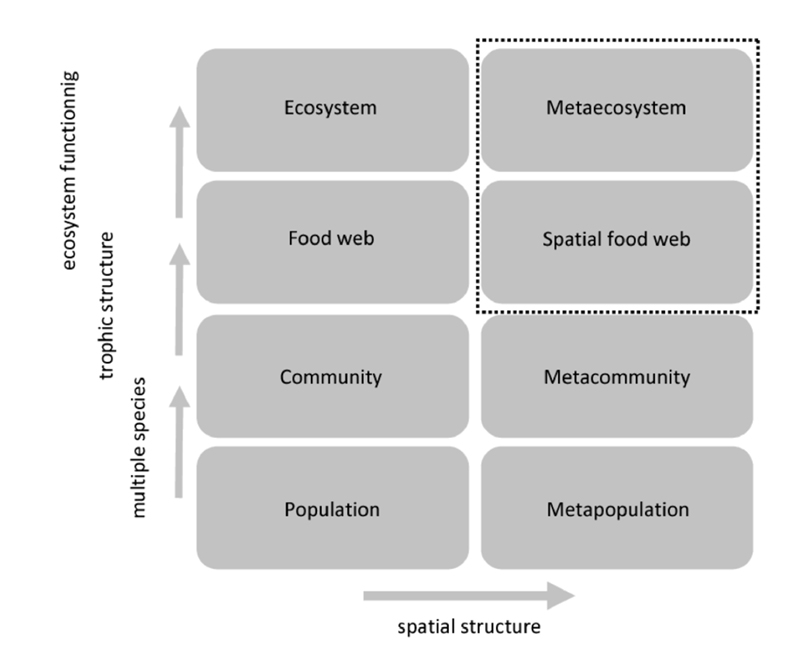
This contribution proposes the meta-ecosystem concept as a natural extension of the metapopulation and metacommunity concepts.
A meta-ecosystem is defined as a set of ecosystems connected by spatial flows of energy, materials and organisms across ecosystem boundaries. This concept provides a powerful theoretical tool to understand the emergent properties that arise from spatial coupling of local ecosystems, such as global source-"sink constraints, diversity-"productivity patterns, stabilization of ecosystem processes and indirect interactions at landscape or regional scales.
The meta-ecosystem perspective thereby has the potential to integrate the perspectives of community and landscape ecology, to provide novel fundamental insights into the dynamics and functioning of ecosystems from local to global scales, and to increase our ability to predict the consequences of land-use changes on biodiversity and the provision of ecosystem services to human societies.