The concept of life-history traits and the study of these traits are the hallmark of population biology. Acknowledging their variability and evolution has allowed us to understand how species adapt in response to their environment.
Th e same traits are also involved in how species alter ecosystems and shape their dynamics and functioning. Some theories, such as the metabolic theory of ecology, ecological stoichiometry or pace-of-life theory, already recognize this junction, but only do so in an implicitly non-spatial context. Meanwhile, for a decade now, it has been argued that ecosystem properties have to be understood at a larger scale using meta-ecosystem theory because source - sink dynamics, community assembly and ecosystem stability are all modifi ed by spatial structure.
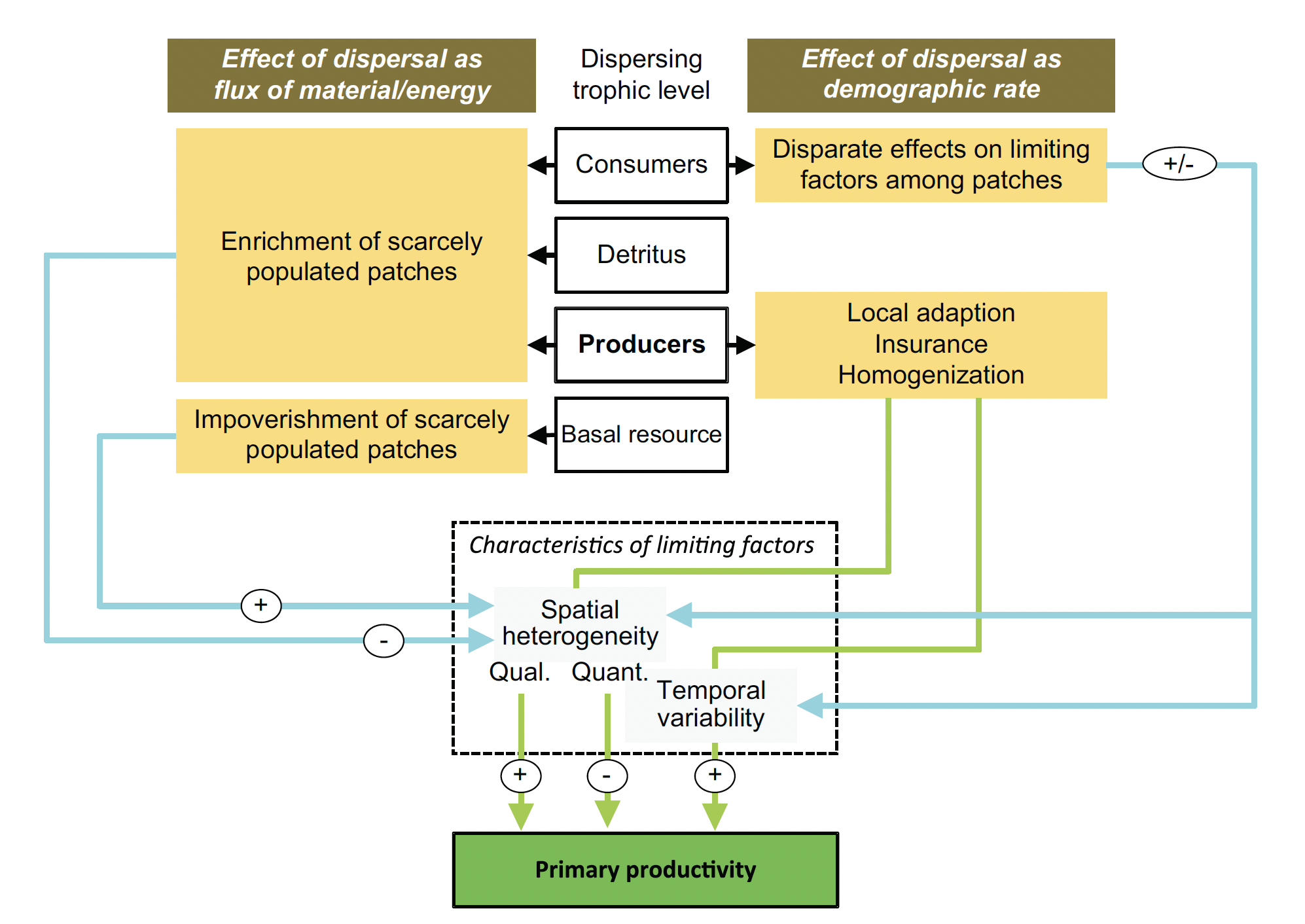
Here, we argue that some ecosystem properties can be linked to a single life-history trait, dispersal, i.e. the tendency of organisms to live, compete and reproduce away from their birth place. By articulating recent theoretical and empirical studies linking ecosystem functioning and dynamics to species dispersal, we aim to highlight both the known connections between life-history traits and ecosystem properties and the unknown areas, which deserve further empirical and theoretical developments.