Keystone species are defined as having disproportionate importance in their community. This concept has proved useful and is now often used in conservation ecology. Here, we introduce the concept of keystone communities (and ecosystems) within metacommunities (and metaecosystems).
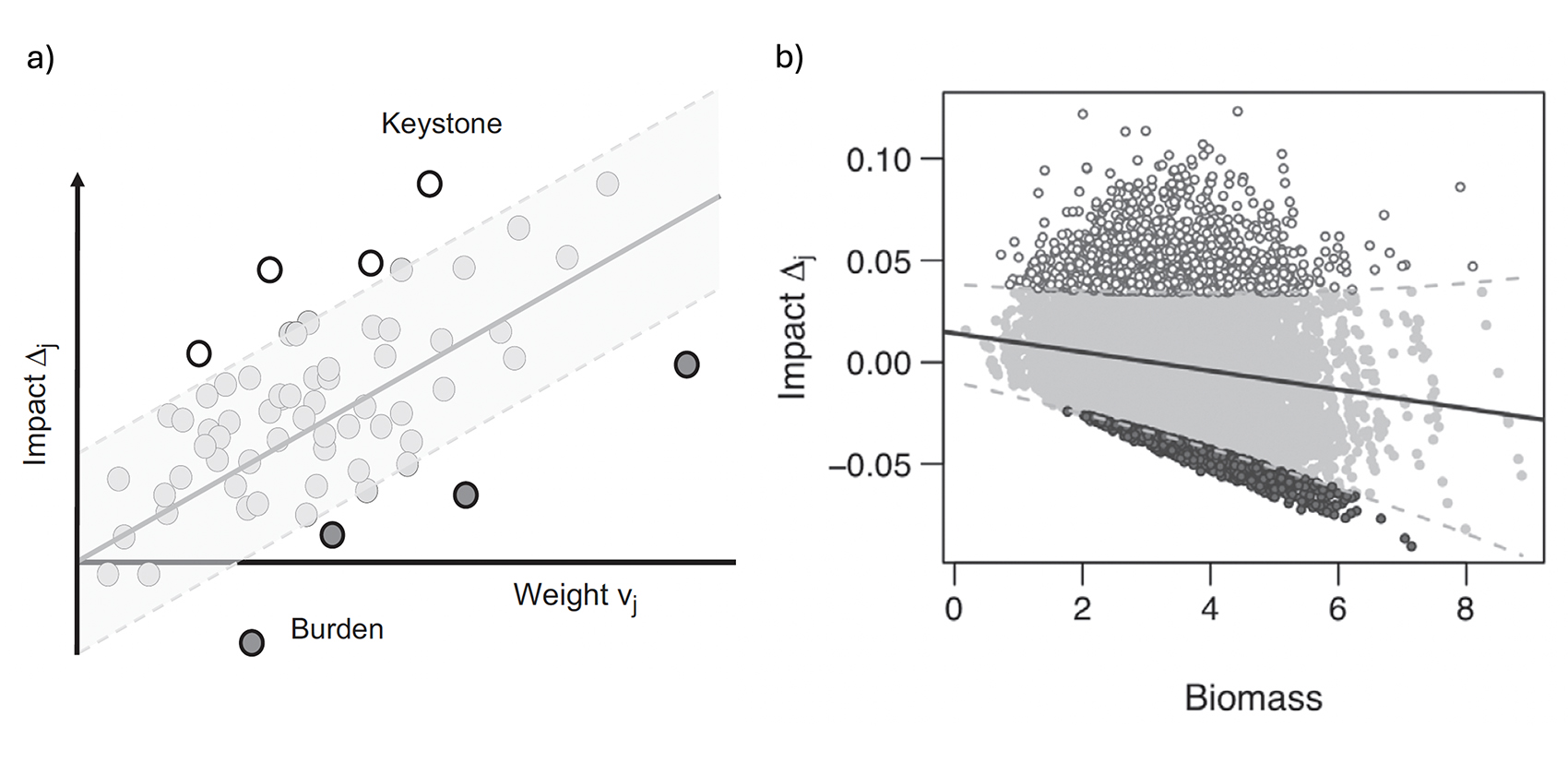
We define keystone and burden communities as communities with impacts disproportionately large (positive or negative respectively) relative to their weight in the metacommunity. We show how a simple metric, based on the effects of single-community removals, can characterise communities along a keystoneness axis.
We illustrate the usefulness of this approach with examples from two different theoretical models. We further distinguish environmental heterogeneity from species trait heterogeneity as determinants of keystoneness. We suggest that the concept of keystone communities/ecosystems will be highly beneficial, not only as a fundamental step towards understanding species interactions in a spatial context, but also as a tool for the management of disturbed landscapes.
a) Conceptual steps in identifying keystone communities. Metacommunity state variables are used to compute a metacommunity property X (e.g. diversity). The impact of removing a focal community j from the metacommunity !j, is calculated by subtracting from X the value of the metacommunity property computed after removing the focal community j. To identify atypical communities, impacts are related to the relative community weight vj (e.g. patch area). The 'keystoneness' of a community is measured as its deviation from the expected impact (i.e. the residual). We define keystone (white circle) and burden (dark grey circle) communities as communities falling outside the threshold of a statistical envelope.. b) Keystoneness in metaecosystem. Ecosystem impacts Deltaj (the change in primary productivity) as a function of total biomass within the focal ecosystem j (ecosystem weights). Keystone ecosystem (respectively burden), according to the best-fitting model with 80% coverage predictions (associated prediction interval is shown as a shaded area) are shown as white-filled circles (respectively dark grey circles).