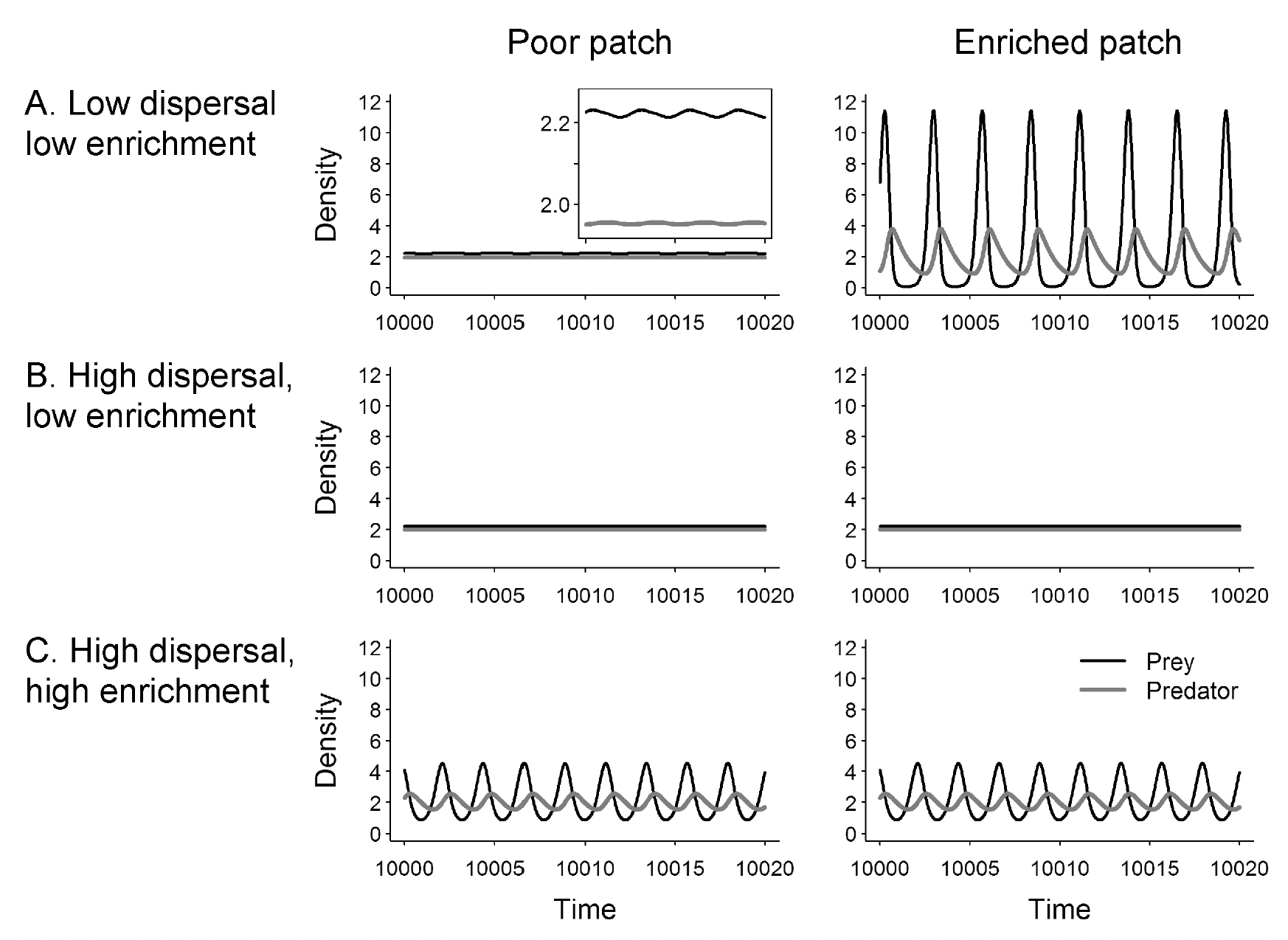
Resource enrichment can destabilize predator-prey dynamics, a phenomenon known as the "paradox of enrichment," mostly studied in homogeneous environments. Yet many predator-prey communities form spatially heterogeneous metacommunities where uneven resource distribution can spread local enrichment effects. Here, we adapted the Rosenzweig-MacArthur predator-prey model to examine how regional enrichment and its spatial distribution affect metacommunity dynamics.
Destabilization depended on both connectivity and enrichment distribution. At low dispersal, enrichment destabilized dynamics, especially when uneven among communities.
In contrast, high dispersal stabilized dynamics under spatially heterogeneous enrichment. These results show that destabilizing effects can be reduced when enrichment occurs at smaller spatial scales than organism movements. From a conservation perspective, spatial heterogeneity may lower regional extinction risk in specialized trophic interactions, while in biological control it may either promote or dampen pest outbreaks depending on the scale of heterogeneity.