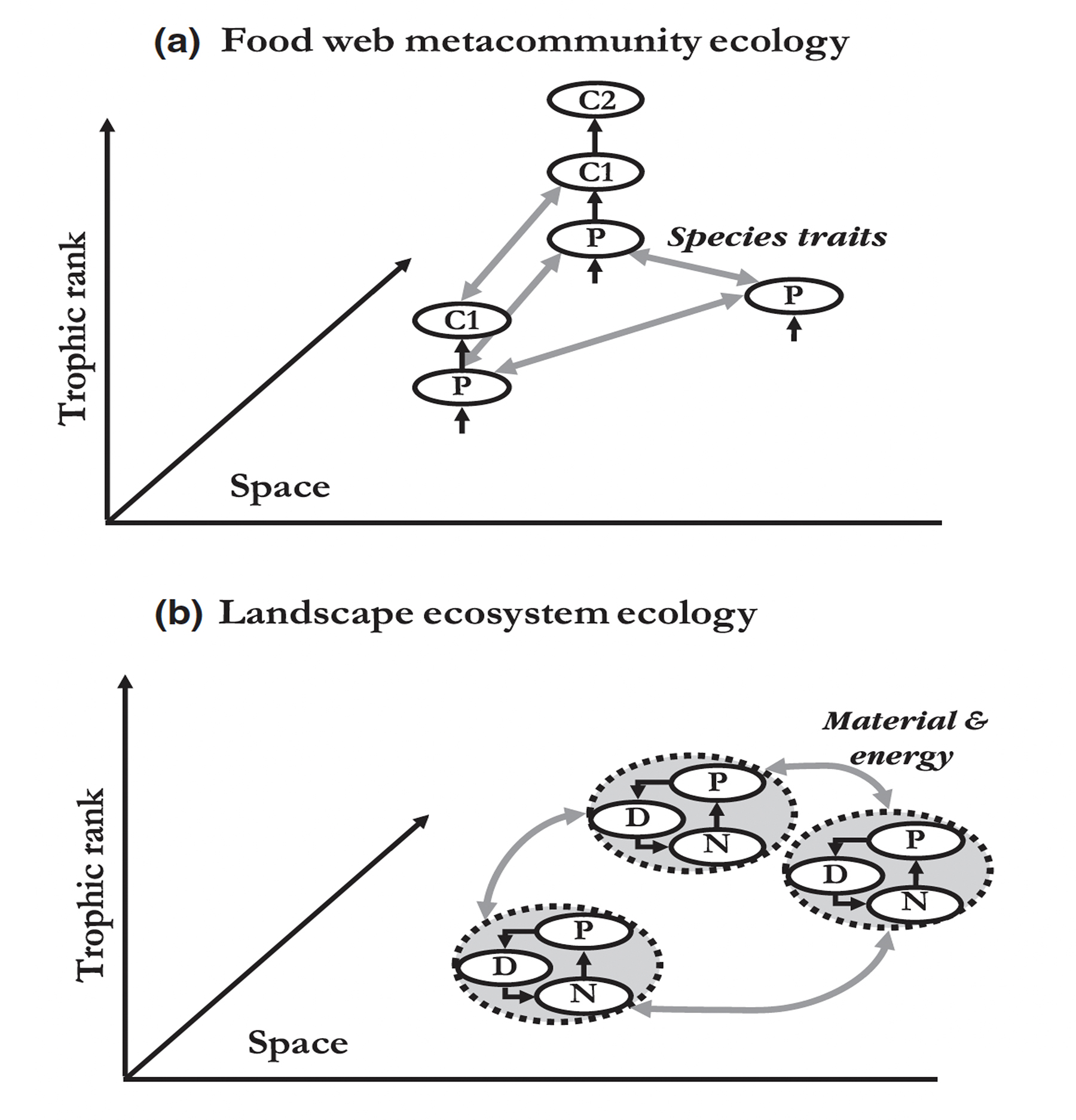
Classical approaches to food webs focus on patterns and processes occurring at the community level rather than at the broader ecosystem scale, and often ignore spatial aspects of the dynamics. However, recent research suggests that spatial processes influence both food web and ecosystem dynamics, and has led to the idea of metaecosystems-EUR.
However, these processes have been tackled separately by -EURfood web metacommunity-EUR ecology, which focuses on the movement of traits, and -EURlandscape ecosystem-EUR ecology, which focuses on the movement of materials among ecosystems. Here, we argue that this conceptual gap must be bridged to fully understand ecosystem dynamics because many natural cases demonstrate the existence of interactions between the movements of traits and materials. This unification of concepts can be achieved under the metaecosystem framework, and we present two models that highlight how this framework yields novel insights.
We then discuss patches, limiting factors and spatial explicitness as key issues to advance metaecosystem theory. We point out future avenues for research on metaecosystem theory and their potential for application to biological conservation.