Ecology Letters · 2006

Coexistence in a metacommunity: the competition-colonization trade-off is not dead

Calcagno V., Mouquet N., Jarne P., David P.

doi.org/10.1111/j.1461-0248.2006.00930.x
Download PDF
Scroll down for preview

Key Message

The competition-colonization trade-off model is commonly used to explain how species coexist, but its validity has been criticized because the original model assumed a strict competitive hierarchy and excluded preemptive effects. This study examined how relaxing these assumptions influences coexistence.

The findings show that weakening the intensity of the trade-off reduces the likelihood of coexistence and creates a minimum colonization threshold below which coexistence cannot occur. Introducing preemption places a limit on how dissimilar species can be. Contrary to expectations from earlier studies, preemption does not necessarily hinder coexistence and may even enhance it.

Its impact depends on whether species in the regional pool are strongly constrained in their colonization ability. Overall, preemption is predicted to promote coexistence when species are not severely limited in colonization and when the competitive trade-off is not infinitely strong.
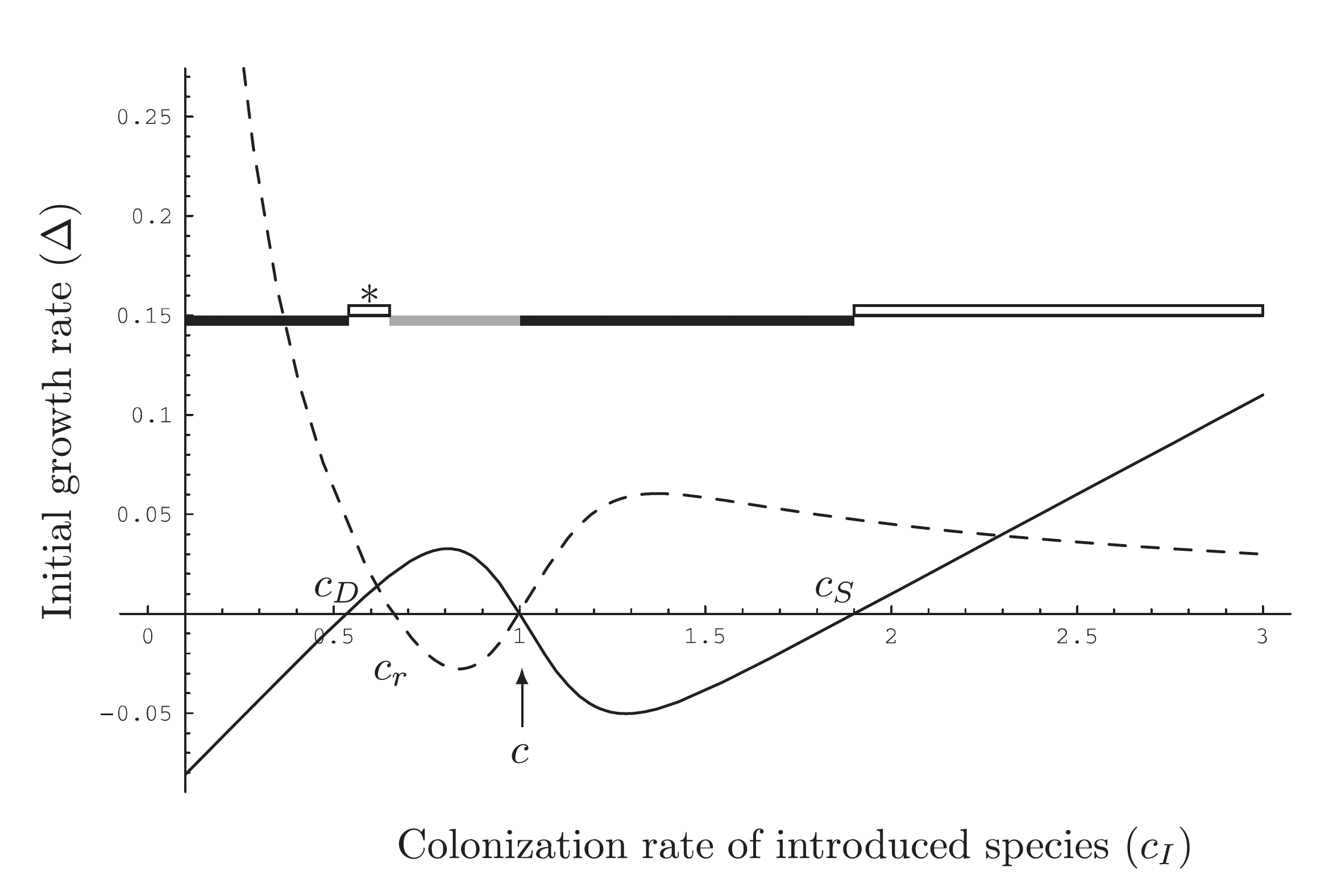
Figure from Calcagno et al. 2006
Niche shadows in the two-species case. For a resident species of strategy (arrow), DI is plotted as a function of cI (continuous line). Niche shadows are values for which DI is negative (dark bands). Note that there is a niche shadow for cI too different from c (the limit to dissimilarity on the left, noted cD ) and for cI too close to c (the limit to similarity, on the right, noted cS ). The value of DI when the values of c and cI are exchanged is also plotted (dashed line). In the region indicated by a grey band, the introduced species competitively excludes the resident species. Coexistence of the two species is possible only where both functions are positive (white bands). W(c, h) is the width of the left white band marked with an asterisk, between cD and c r.
Full Article (PDF)