PLoS ONE · 2012

Emergence of Structural Patterns in Neutral Trophic Networks

Canard E., Mouquet N., Marescot L., Gaston K.J., Gravel D., Mouillot D.

doi.org/10.1371/journal.pone.0038295
Download PDF
Scroll down for preview

Key Message

An emerging consensus posits that both niche and neutral mechanisms simultaneously shape many features of ecological communities. However, the study of interaction networks still lacks a comprehensive neutral theory.

Here we present a neutral model of predator-prey interactions and analyze the structural characteristics of the simulated networks. We find that connectance values (complexity) and complexity-diversity relationships of neutral networks are close to those observed in empirical bipartite networks. High nestedness and low modularity values observed in neutral networks fall in the range of those from empirical antagonist bipartite networks.

Our results suggest that, as an alternative to niche-mediated processes that induce incompatibility between species (niche forbidden links), neutral processes create neutral forbidden links due to uneven species abundance distributions and the low probability of interaction between rare species. Neutral trophic networks must be seen as the missing endpoint of a continuum from niche to purely stochastic approaches of community organization.
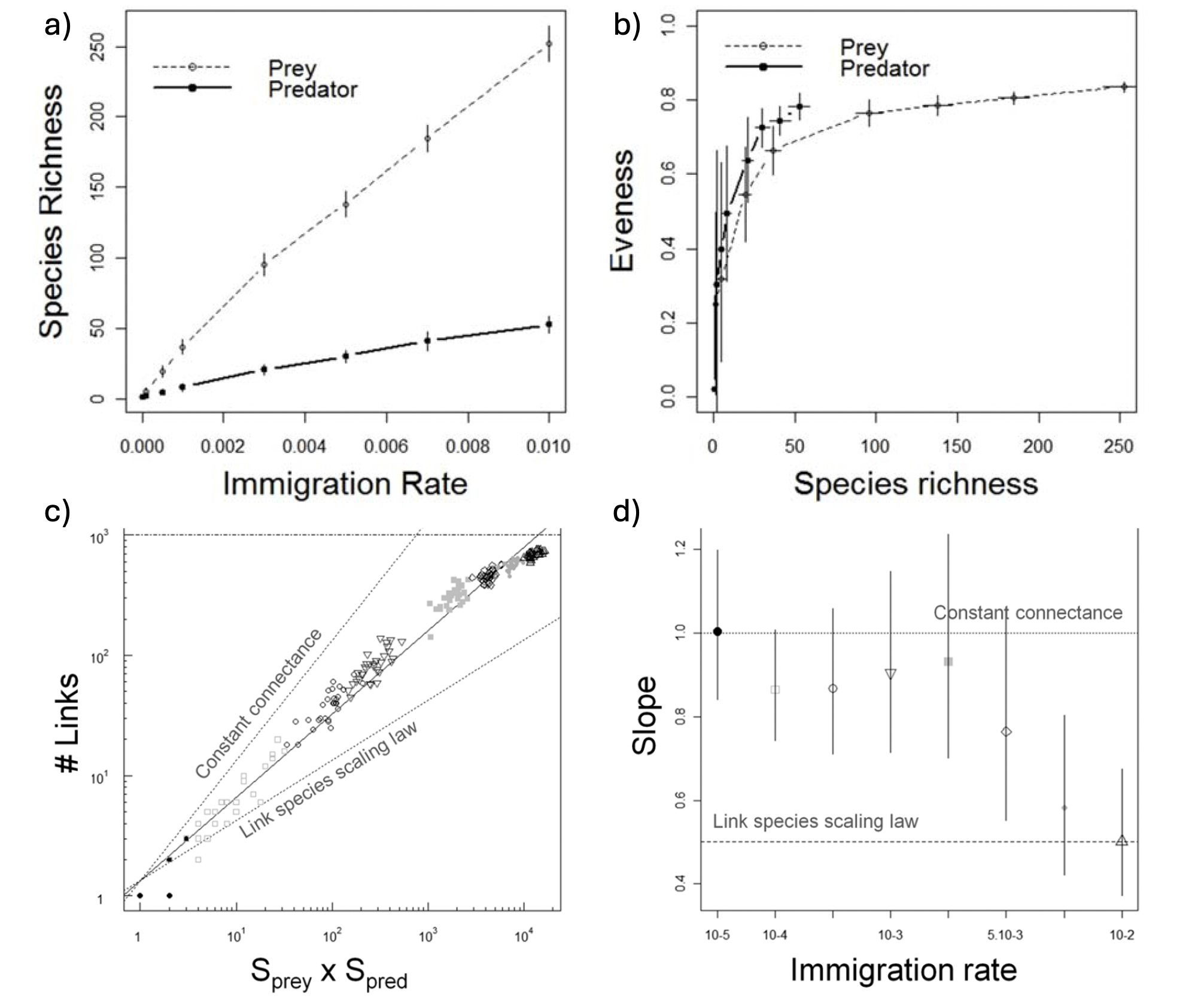
Figure from Canard et al. 2012
a) Species richness as a function of immigration rate, and b) evenness of predator and prey communities as a function of species richness at each trophic level. Total species richness is the total number of species in the network. Error bars represent standard deviation over the 30 replicates. (c,d) Relationship between complexity (number of links, L) and diversity (??prey + ??pred) at equilibrium for different immigration rates. a) Log-log type II regression across all simulated networks (30 replicates x 8 immigration rates) with a slope of 0.697 (R^2 = 0.99, p < 2 x 10???^1???). The upper dashed line indicates the maximum possible number of links, while dotted lines represent the constant connectance hypothesis (slope = 1) and the link-species scaling law (slope = 0.5). b) Slopes of the log-log type II regressions calculated for each immigration rate.
Full Article (PDF)