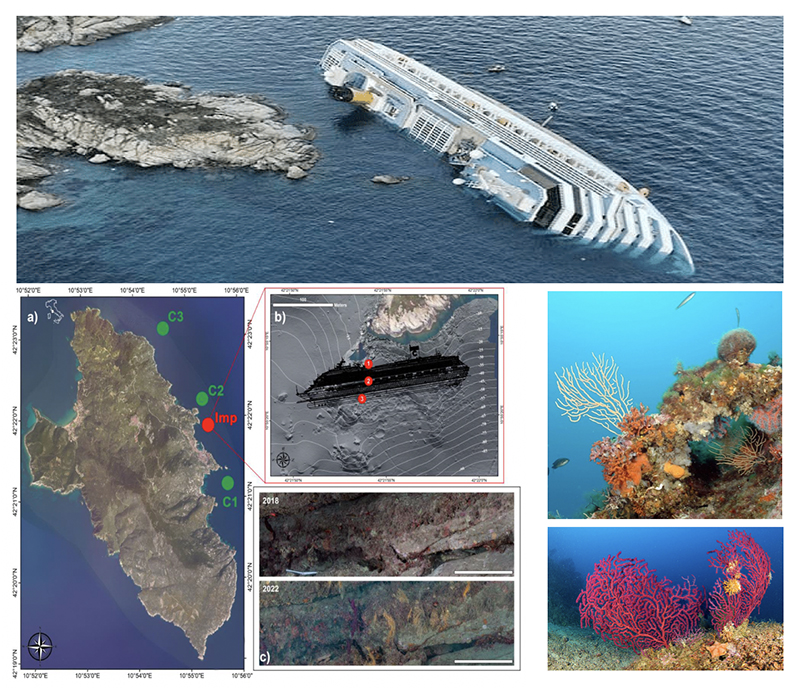
We assessed recolonization dynamics of bare coralligenous reefs and the effectiveness of restoration actions, combining disturbance removal with transplantation of Eunicella cavolini and Paramuricea clavata after the Costa Concordia shipwreck. We quantified transplantation and monitored community dynamics, diversity, and aesthetic value at impacted and nearby control sites.
Recolonization was slow, with increasing species richness over time and dominance of perennial encrusting algae. Transplanted colonies showed high survival and increased density and cover, while no natural recruitment was observed.
Ecological metrics improved steadily but remained lower than in control sites, whereas by 2020 the aesthetic value of impacted reefs matched controls. These results show that disturbance removal and transplantation of erect species can support structural and visual recovery, although full recovery requires long-term protection, monitoring, and consideration of cultural ecosystem services.