We argue that a theory of species co-occurrence in ecological networks is needed to improve interpretation of co-occurrence data, test community assembly mechanisms, and extend species distribution analyses beyond abiotic factors.
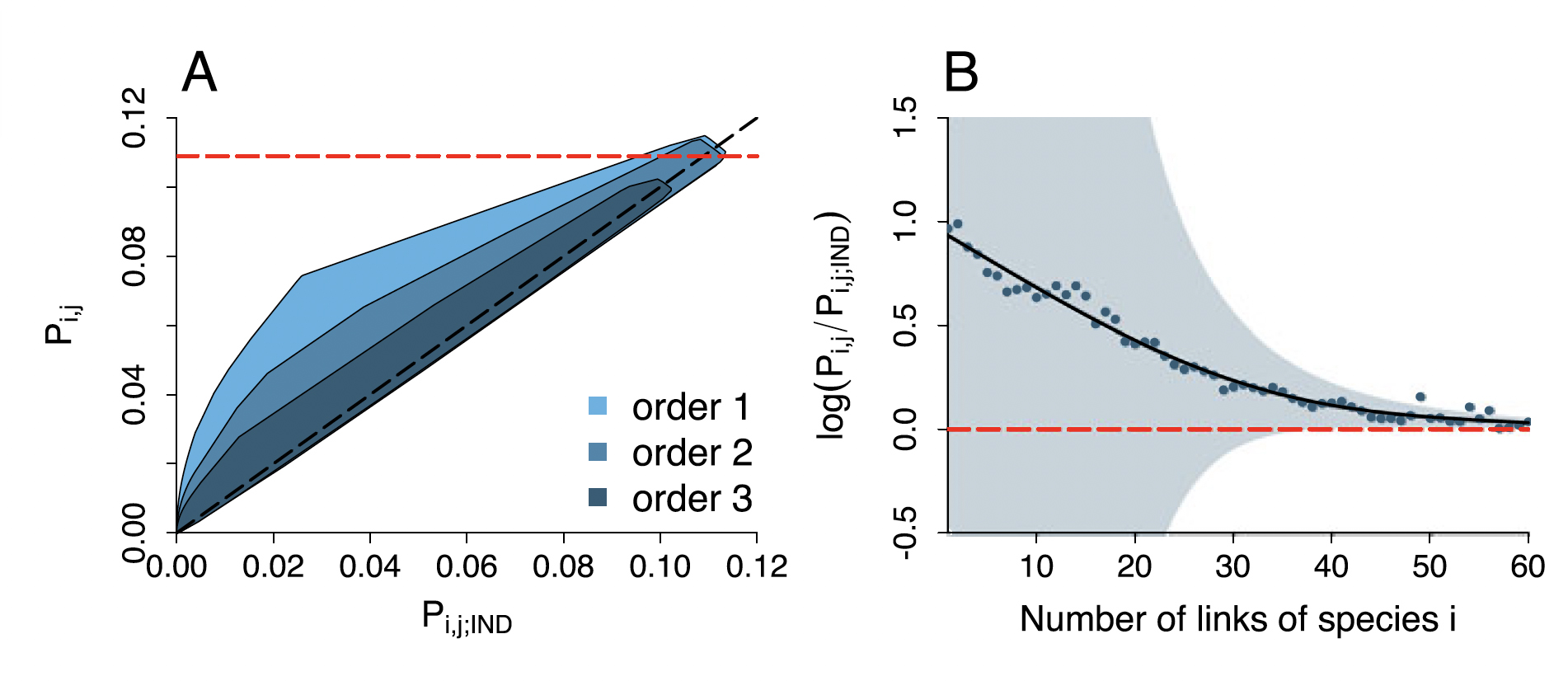
This paper provides initial building blocks for such a theory by formalizing key probabilities used in co-occurrence studies. Through analysis of three interaction modules and multi-species simulations, we identify five principles shaping species associations: direct and indirect interactions affect pairwise co-occurrence, co-occurrence is rarely symmetric, and association strength decreases with both network distance and the number of interactions.
Our results highlight the difficulty of inferring interactions from co-occurrence data, question the feasibility of reconstructing networks from such data, and suggest that species distribution models could be improved by incorporating interaction-based probabilities.