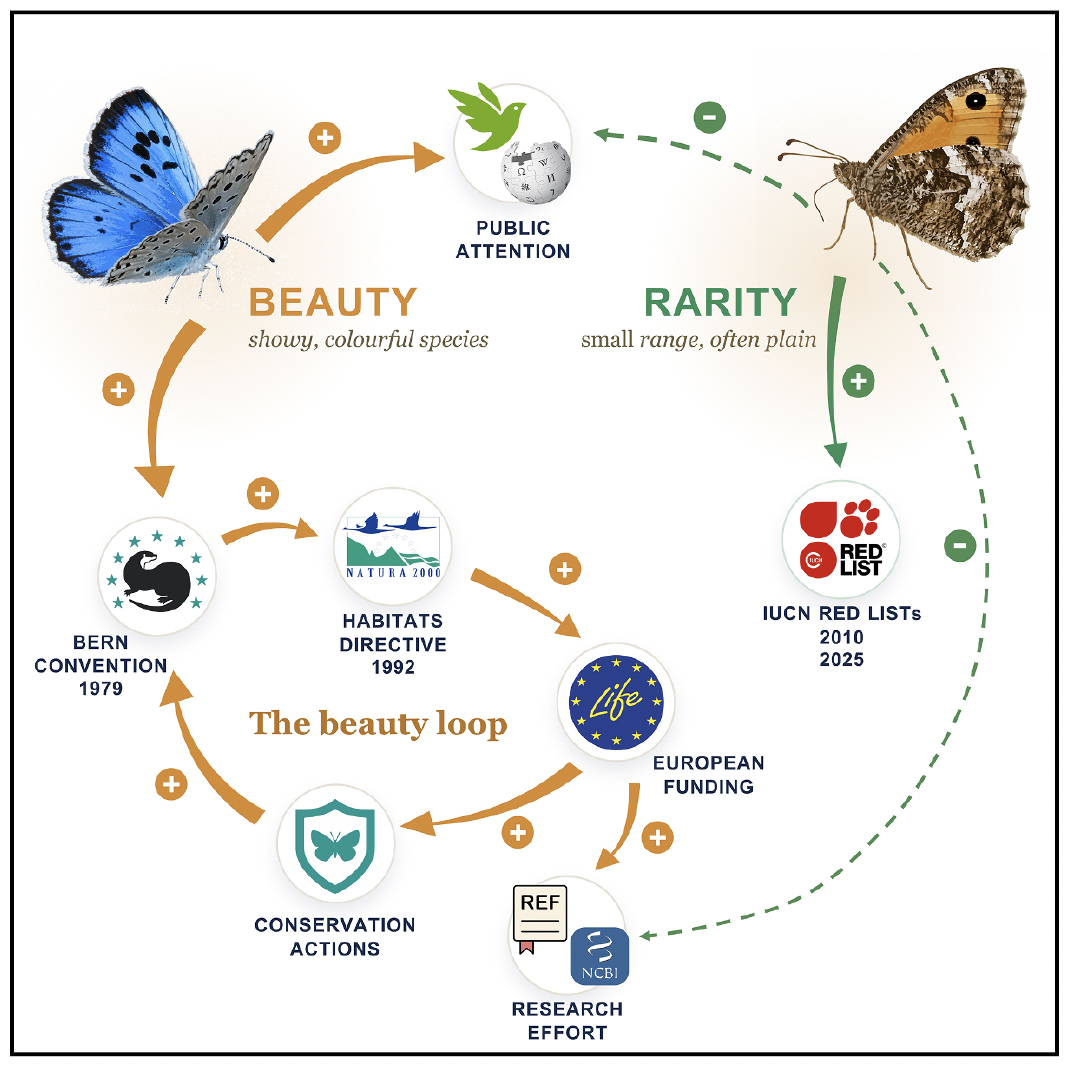
Conservation biases have been documented since the first emergence of the concept of biodiversity in the 1980s, showing a systematic disproportion in the allocation of research and conservation efforts among taxa. One factor underlying this disproportion, gaining prominence in recent literature, is species' perceived beauty, shaped by human visual preferences. Here, we integrate a large-scale survey of the perceived beauty of European butterflies yielding >21,000 survey completions from >100 countries into a time-explicit network linking species' beauty, public attention, research and conservation efforts, and the EU regulatory framework.
We found that species beauty is consistently associated with public attention, research, and conservation efforts in a temporally structured pattern compatible with a cumulative beauty bias. Research effort and public attention concentrate on widespread and visually attractive species, whereas species included in the legal conservation framework, particularly the Convention on the Conservation of European Wildlife and Natural Habitats (hereafter, Bern Convention, BC, 1979) and the EU Habitats Directive (hereafter, HD, 1992) are disproportionately represented by visually appealing and historically protected taxa. Because these frameworks guide funding and management actions, early associations between species beauty and BC/HD inclusion have contributed to long-lasting institutional patterns in butterfly research and conservation.
By contrast, European IUCN Red Lists do not overrepresent beautiful species and identify more inconspicuous taxa as threatened. This mismatch reveals a tension between scientific assessments of extinction risk and historically embedded conservation priorities. Our findings suggest that recognizing beauty bias is vital for aligning conservation with actual ecological urgency.