Ecological specialization is one of the main concepts in ecology and conservation. However, this concept has become highly context-dependent and is now obscured by the great variability of existing definitions and methods used to characterize ecological specialization. In this review, we clarify this concept by reviewing the strengths and limitations of different approaches commonly used to define and measure ecological specialization.
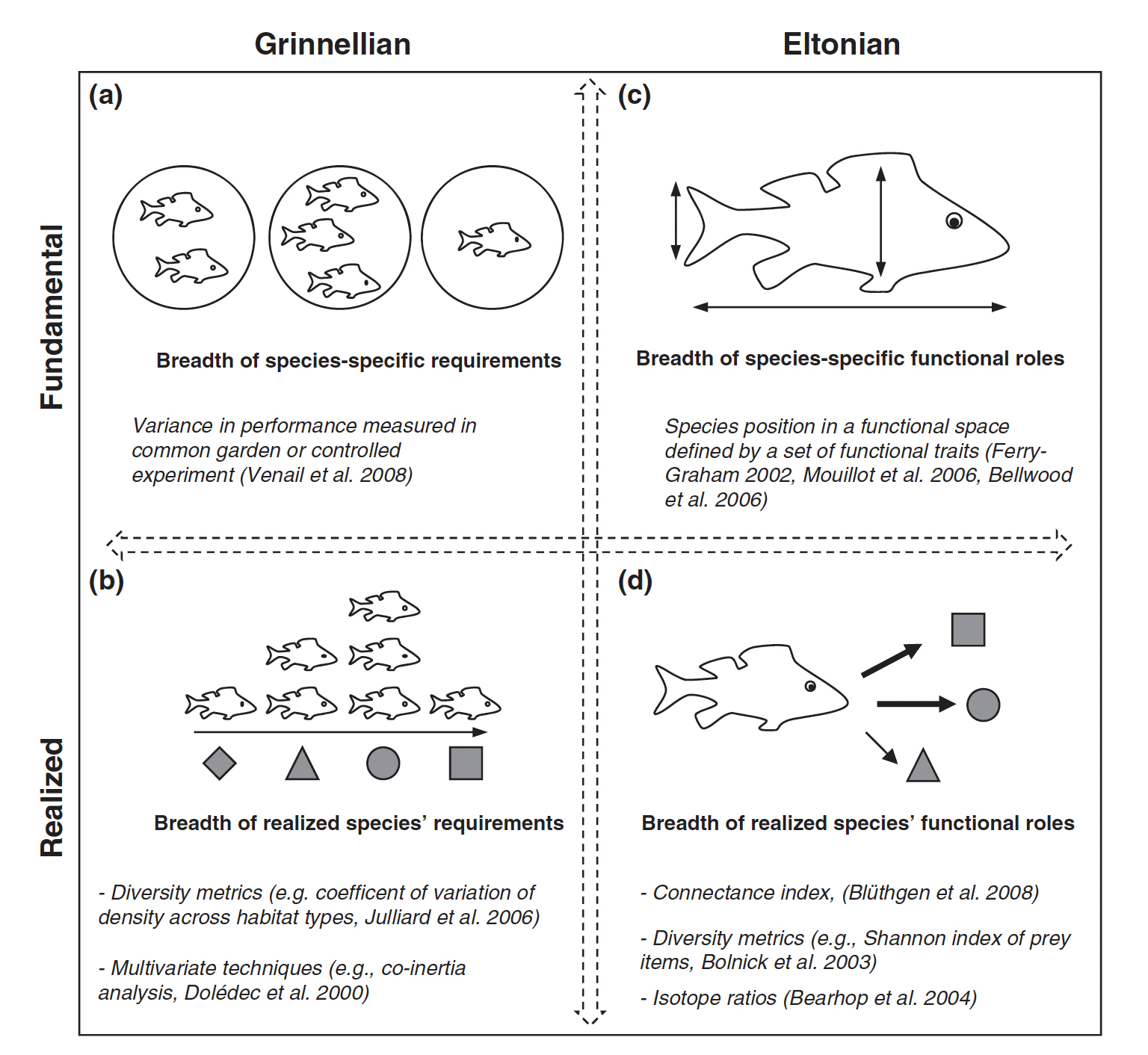
We show that ecological specialization can either be considered as reflecting species' requirements or species' impacts. We explain how specialization depends on species-specific characteristics and on local and contingent environmental constraints. We show why and how ecological specialization should be scaled across spatial and temporal scales, and from individuals to communities.
We illustrate how this review can be used as a practical toolbox to classify widely used metrics of ecological specialization in applied ecology, depending on the question being addressed, the method used, and the data available. Clarifying ecological specialization is useful to make explicit connections between several fields of ecology using the niche concept. Understanding the different facets of ecological specialization should facilitate to investigate the causes and consequences of biotic homogenization and to derive relevant indicators of biodiversity responses to land-use changes.