MacArthur and Wilson!s Theory of Island Biogeography (TIB) is among the most well-known process-based explanations for the distribution of species richness. It helps understand the species-"area relationship, a interactions and derive a species-specific model for occurrence probability.
We find that the properties of the dynamics affect local food web properties.
We compare the accuracy of the classic TIB to our trophic TIB to TIB. Our approach provides a parsimonious explanation to species distributions and open new perspectives to integrate the complexity of ecological interactions into simple species distribution models.
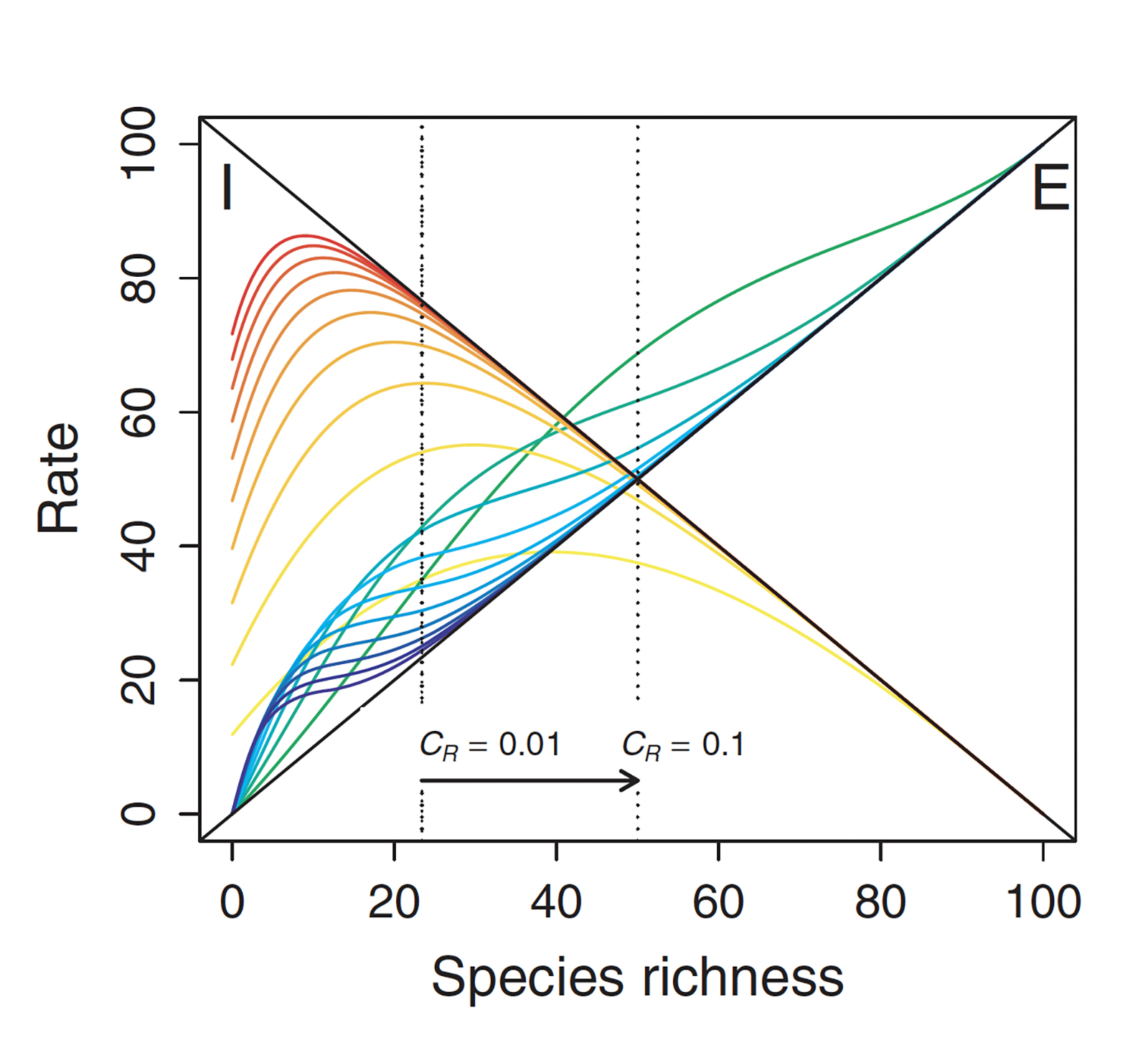
Adding a trophic constraint on species immigration and extinction affects the equilibrium species richness in a local community (note all consumer have the same diet breadth for the illustration). The classic TIB is depicted with the black lines. Species richness in a local community is found when the immigration rate equals the extinction rate (when the respective I and E curves cross, depicted by the vertical dotted lines). The coloured lines for the trophic TIB are obtained following the analytical approximation in the online supporting information. The connectance in the regional species pool is varied between 0.01 (yellow and green for the immigration and extinction curves, respectively) and 0.1 (red and blue curves, respectively).