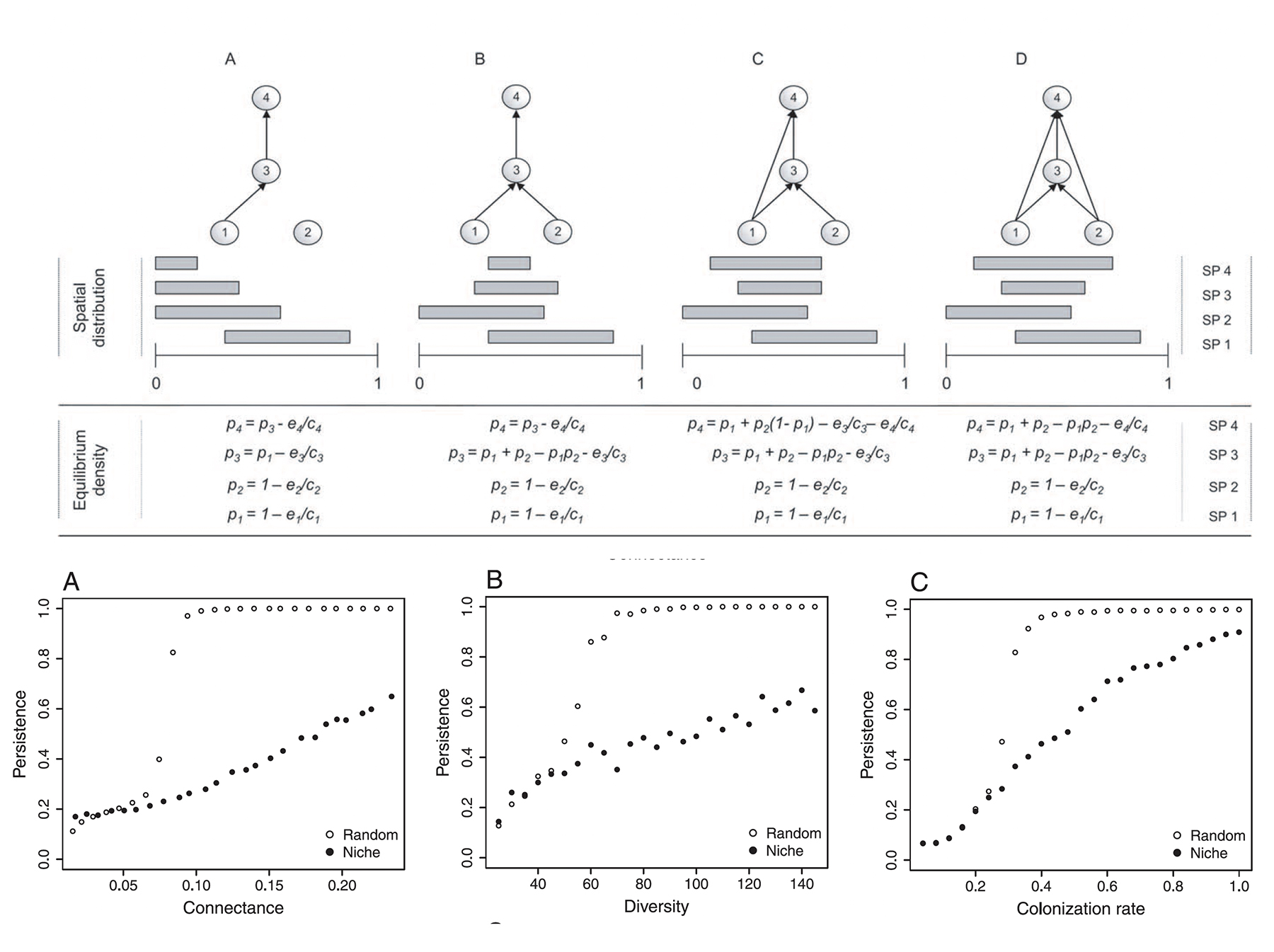
We are interested in understanding if metacommunity dynamics contribute to the persistence of complex spatial food webs subject to colonization-extinction dynamics. We study persistence as a measure of stability of communities within discrete patches, and ask how do species diversity, connectance, and topology influence it in spatially structured food webs. We answer this question first by identifying two general mechanisms linking topology of simple food web modules and persistence at the regional scale.
We then assess the robustness of these mechanisms to more complex food webs with simulations based on randomly created and empirical webs found in the literature. We find that linkage proximity to primary producers and food web diversity generate a positive relationship between complexity and persistence in spatial food webs. The comparison between empirical and randomly created food webs reveal that the most important element for food web persistence under spatial colonization-extinction dynamics is the degree distribution: the number of prey species per consumer is more important than their identity. With a simple set of rules governing patch colonization and extinction, we have predicted that diversity and connectance promote persistence at the regional scale.
The strength of our approach is that it reconciles the effect of complexity on stability at the local and the regional scale. Even if complex food webs are locally prone to extinction, we have shown their complexity could also promote their persistence through regional dynamics. The framework we presented here offers a novel and simple approach to understand the complexity of spatial food webs.