There is consensus that biodiversity losses will result in declining ecosystem functioning if species have different functional traits. Phylogenetic diversity has recently been suggested as a predictor of ecosystem functioning because it could approximate the functional complementarity among species.
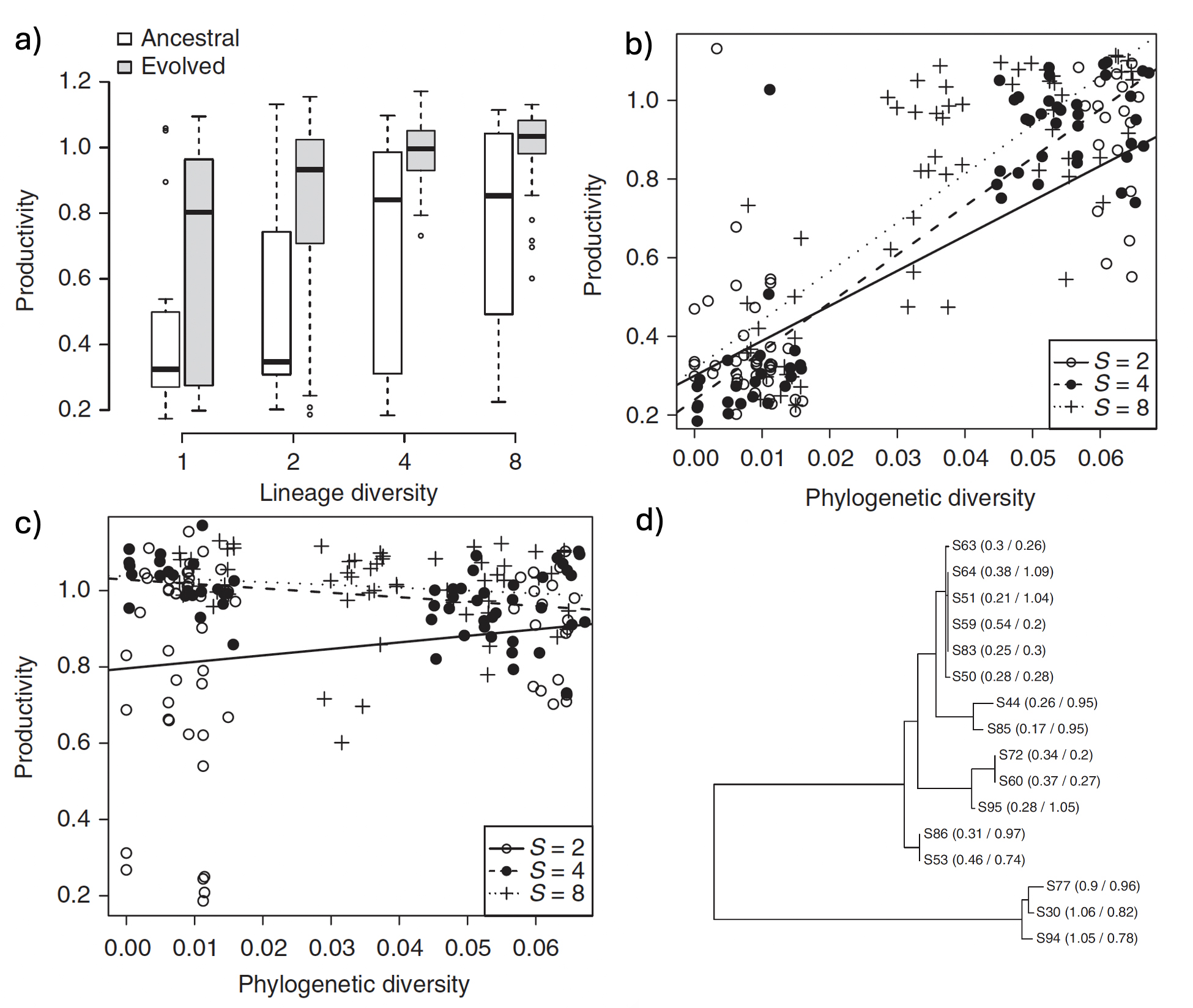
Here we describe an experiment that takes advantage of the rapid evolutionary response of bacteria to disentangle the role of phylogenetic and species diversity. We impose a strong selection regime on marine bacterial lineages and assemble the ancestral and evolved lines in microcosms of varying lineage and phylogenetic diversity.
We find that the relationship between phylogenetic diversity and productivity is strong for the ancestral lineages but brakes down for the evolved lineages. Our results not only emphasize the potential of using phylogeny to evaluate ecosystem functioning, but also they warn against using phylogenetics as a proxy for functional diversity without good information on species evolutionary history.