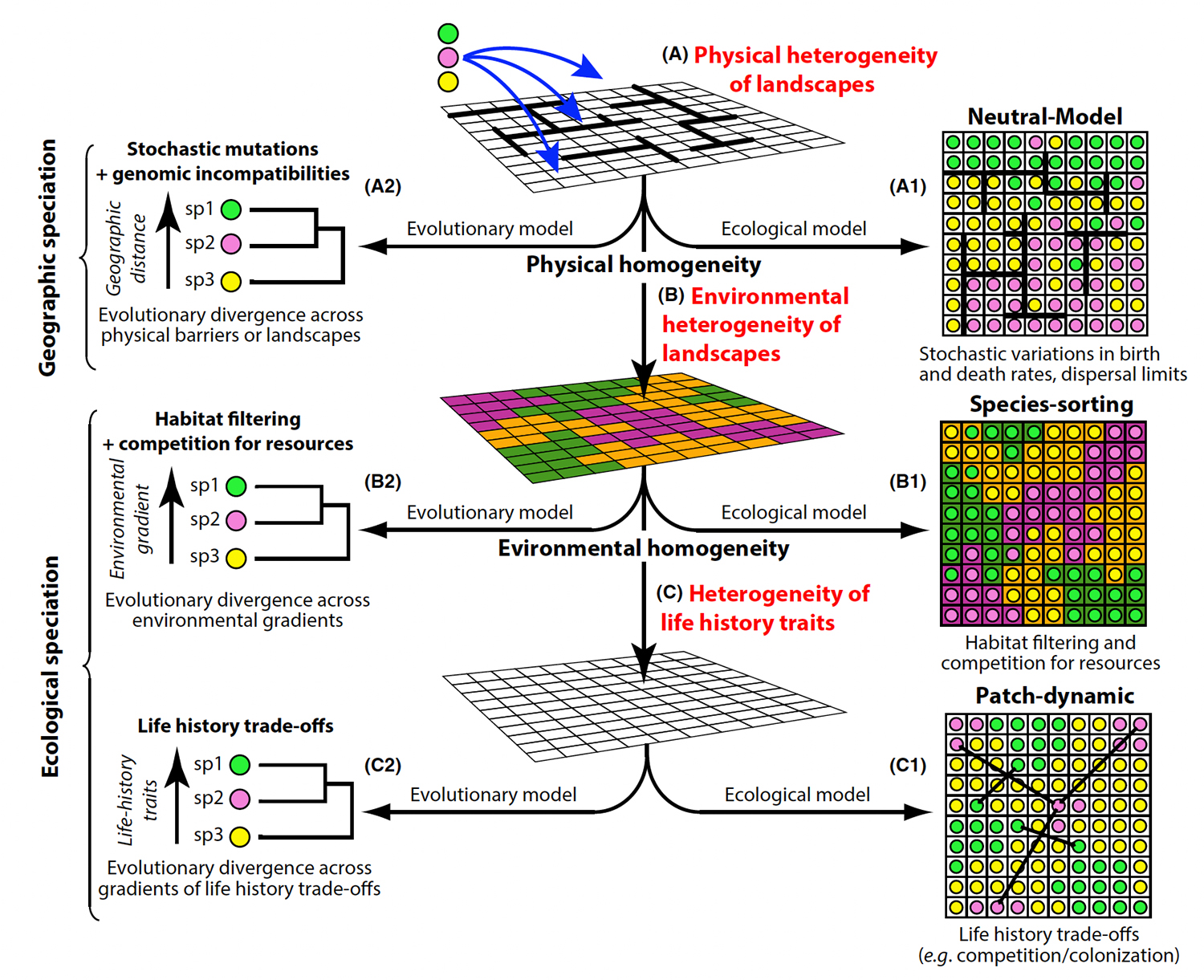
The emergence of new frameworks combining evolutionary and ecological dynamics in communities opens new perspectives on the study of speciation. By acknowledging the relative contribution of local and regional dynamics in shaping the complexity of ecological communities, metacommunity theory sheds a new light on the mechanisms underlying the emergence of species.
Three integrative frameworks have been proposed, involving neutral dynamics, niche theory, and life history trade-offs respectively.
Here, we review these frameworks of metacommunity theory to emphasise that: (1) studies on speciation and community ecology have converged towards similar general principles by acknowledging the central role of dispersal in metacommunities dynamics, (2) considering the conditions of emergence and maintenance of new species in communities has given rise to new models of speciation embedded in the metacommunity theory, (3) studies of diversification have shifted from relating phylogenetic patterns to landscapes spatial and ecological characteristics towards integrative approaches that explicitly consider speciation in a mechanistic ecological framework. We highlight several challenges, in particular the need for a better integration of the eco-evolutionary consequences of dispersal and the need to increase our understanding on the relative rates of evolutionary and ecological changes in communities.