Biology Letters · 2016

Predicting biotic interactions and their variability in a changing environment

Kadowaki K., Barbera C., Godsoe W., Delsuc F., Mouquet N.

doi.org/10.1098/rsbl.2015.1073
Download PDF
Scroll down for preview

Key Message

Global environmental change is altering the patterns of biodiversity worldwide. Observation and theory suggest that species' distributions and abundances depend on a suite of processes, notably abiotic filtering and biotic interactions, both of which are constrained by species' phylogenetic history.

Models predicting species distribution have historically mostly considered abiotic filtering and are only starting to integrate biotic interaction.

However, using information on present interactions to forecast the future of biodiversity supposes that biotic interactions will not change when species are confronted with new environments. Using bacterial microcosms, we illustrate how biotic interactions can vary along an environmental gradient and how this variability can depend on the phylogenetic distance between interacting species.
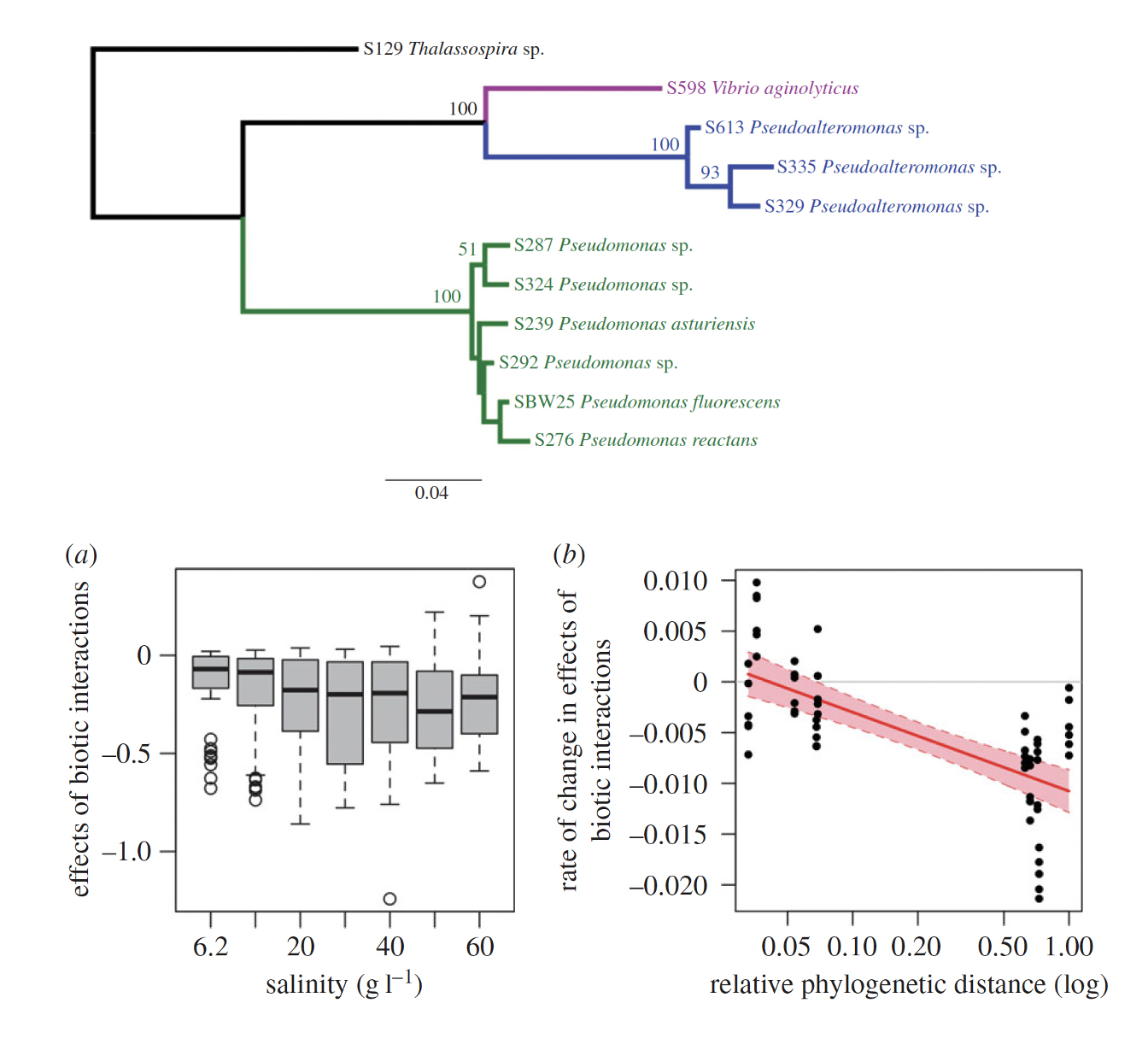
Figure from Kadowaki et al. 2016
Up: Phylogeny. Maximum-likelihood tree of the 11 marine strains, with node values indicating bootstrap support (>50). Phylogenetic distance was measured as patristic distance (sum of branch lengths on the 16S rRNA tree). Below: Effects of biotic interactions on abundance of Pseudomonas fluorescens along salinity and phylogenetic gradients. (a) Interaction effects on P. fluorescens SBW25 become more negative with increasing salinity. (b) The change in interaction effects with salinity increases with phylogenetic distance between strains, where the predictor is phylogenetic distance and the response is the change in D along the salinity gradient.
Full Article (PDF)