PLoS Biology · 2022

The aesthetic value of reef fishes is globally mismatched to their conservation priorities

Langlois J.*, Guilhaumon F., Baletaud F., Casajus N., Braga C.D.A., Fleure V., Kulbicki M., Loiseau N., Mouillot D., Renoult J.P., Stahl A., Stuart-Smith R.D., Tribot A., Mouquet N.*

(* These authors contributed equally to this study)

doi.org/10.1371/journal.pbio.3001640
Download PDF
Scroll down for preview

Key Message

Aesthetic value represents one of the most immediate and direct means by which human societies engage with biodiversity, and can be critical drivers of conservation investment. Here, we provide the aesthetic value of 2,417 ray-finned reef fish species by combining intensive evaluation of photographs of fishes by humans with predicted values from machine learning.

We identified important biases in species aesthetic value relating to evolutionary history, ecological traits, and IUCN threat status. The most beautiful fishes are tightly packed into small parts of both the phylogenetic tree and the ecological trait space.

In contrast, the less attractive fishes are the most ecologically and evolutionary distinct species and those recognized as threatened. Our study highlights likely important mismatches between potential public support for conservation and the species most in need of this support.
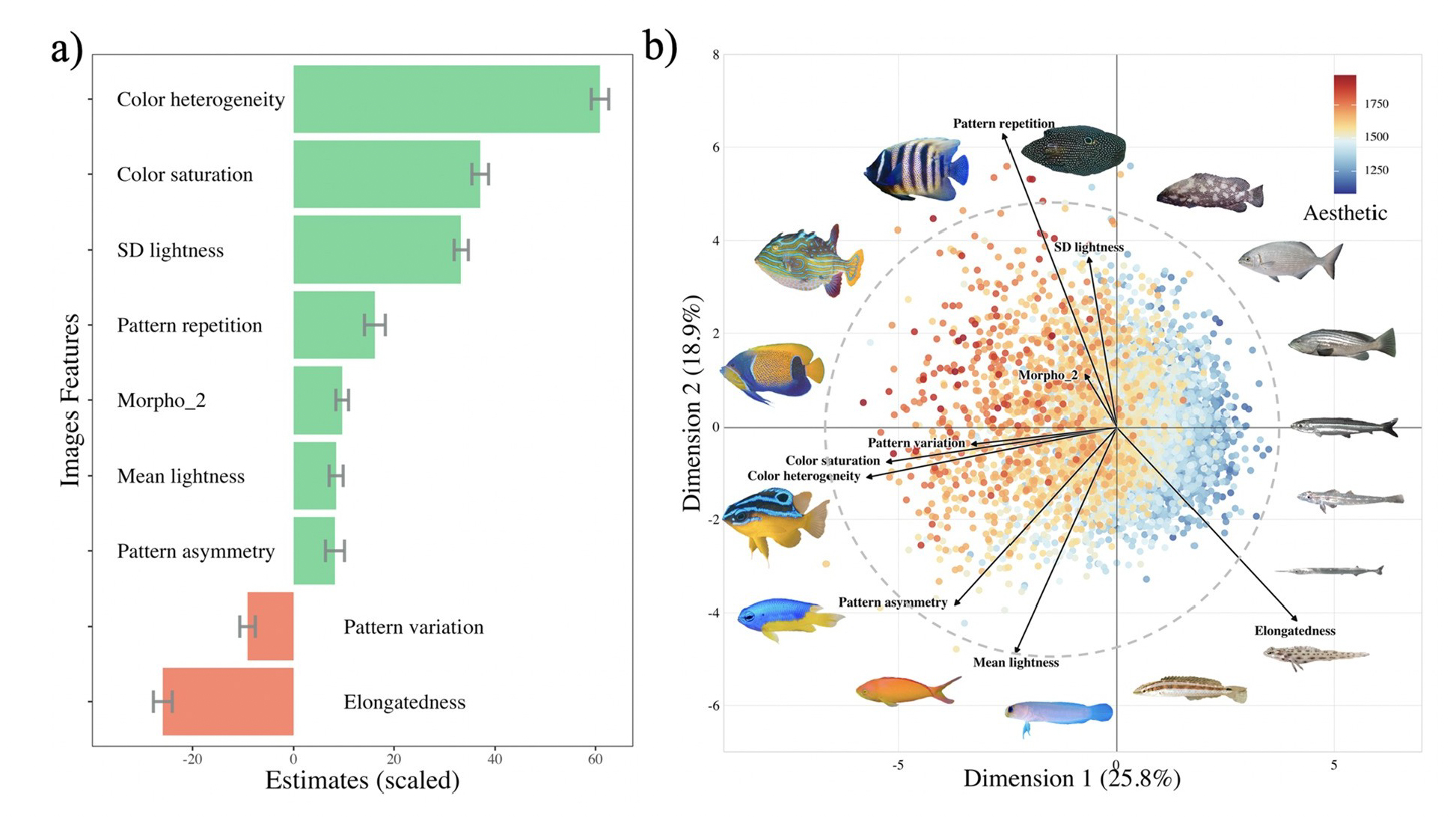
Figure from Langlois et al. 2022
(a) Regression coefficients (with standard errors) from the final model between the aesthetic value and the 9 significant image features. (b) Principal Component Analysis (PC1 and PC2) performed with the 9 significant images features. Points (fishes) are colored by their aesthetic values, and image feature vectors are projected on the 2 axes. Examples of fishes (chosen on the perimeter of the distribution) are provided for illustration. Clockwise order: Calloplesiops altivelis, Epinephelus ongus, Kyphosus vaigiensis, Epinephelus costae, Jenkinsia lamprotaenia, Phyllogobius platycephalops, Belone belone, Ctenogobiops crocineus, Suezichthys devisi, Opistognathus aurifrons, Pseudanthias ignitus, Pomacentrus auriventris, Mecaenichthys immaculatus, Pomacanthus navarchus, Aracana aurita, Pomacanthus sexstriatus.
Full Article (PDF)