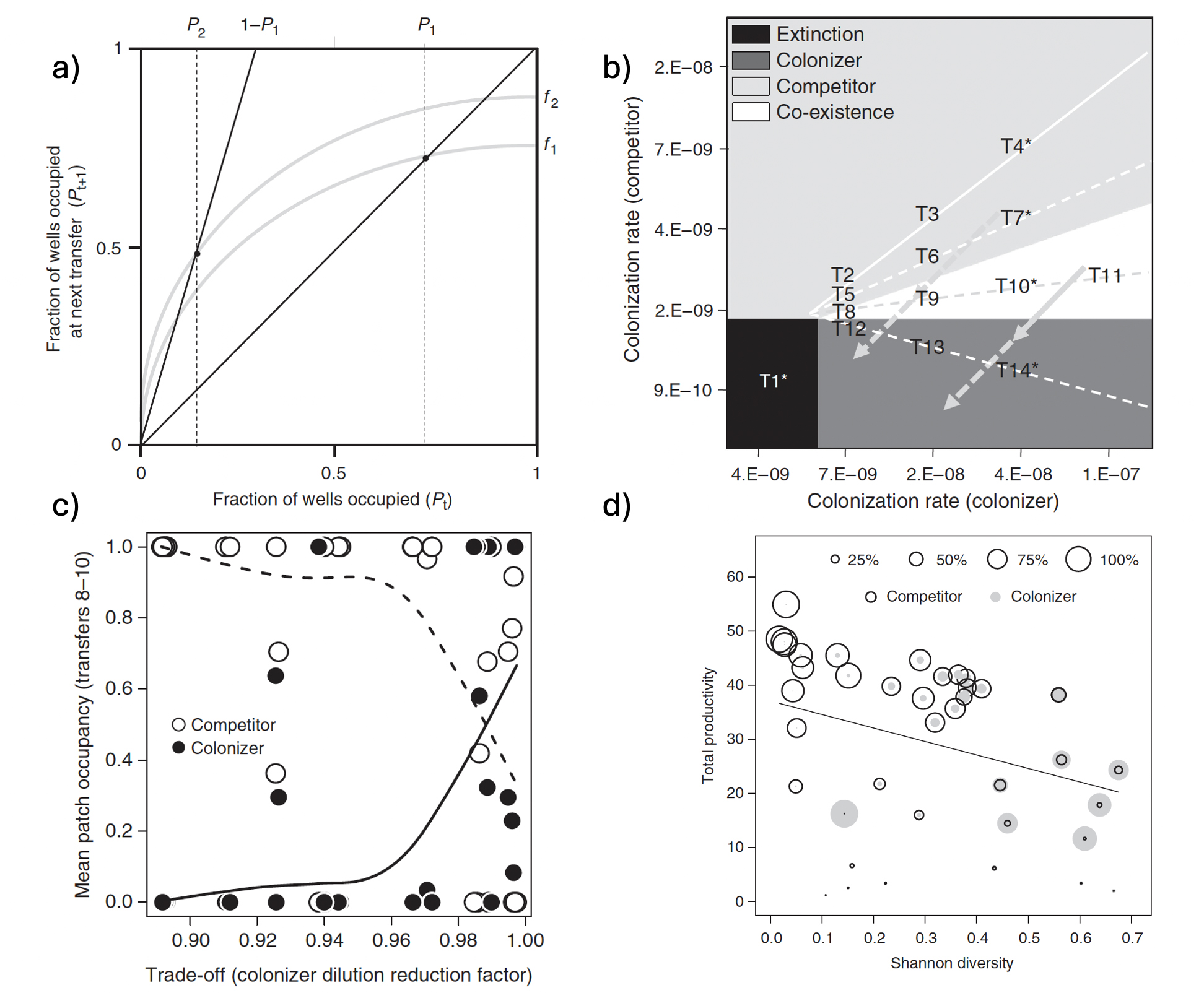
Competition-colonization trade-offs are widely proposed as a fundamental mechanism promoting species coexistence in spatially structured landscapes, yet direct experimental evidence for the dynamics predicted by these models remains scarce. Here, we experimentally tested competition-colonization dynamics using two Pseudomonas bacterial strains assembled into controlled metacommunities.
By independently manipulating trade-off strength and colonization rates across replicated microplate landscapes, we recreated the full range of theoretical coexistence outcomes predicted by competition-colonization theory, including stable coexistence, competitive exclusion, and extinction under extremely low colonization. Moderate trade-off strengths promoted long-term coexistence and balanced patch occupancy, whereas weak or strong trade-offs favored exclusion of either the superior colonizer or the dominant competitor. Furthermore, experimentally increasing habitat isolation altered persistence dynamics and generated delayed extinction responses consistent with extinction debt theory, highlighting the sensitivity of coexistence mechanisms to landscape connectivity.
We also detected a negative relationship between regional diversity and metacommunity productivity because competitively dominant strains exhibited higher productivity than superior colonizers. Together, these findings provide one of the first direct experimental validations of competition-colonization theory and demonstrate how dispersal limitation, habitat fragmentation, and competitive asymmetries jointly shape biodiversity patterns and ecosystem functioning in spatially structured systems.