Trends in Ecology & Evolution · 2011

Empirical approaches to metacommunities: a review and comparison with theory

Logue J.B., Mouquet N., Peter H., Hillebrand H.

doi.org/10.1016/j.tree.2011.04.009
Download PDF
Scroll down for preview

Key Message

Metacommunity theory has advanced understanding of how spatial dynamics and local interactions shape community structure and biodiversity. Here, we review empirical approaches to metacommunities, both observational and experimental, pertaining to how well they relate to and test theoretical metacommunity paradigms and how well they capture the realities of natural ecosystems.

First, we show that the species-sorting and mass effects paradigms are the most commonly tested and supported paradigms. Second, the dynamics observed can often be ascribed to two or more of the four non-exclusive paradigms. Third, empirical approaches relate only weakly to the concise assumptions and predictions made by the paradigms.

Consequently, we suggest major avenues of improvement for empirical metacommunity approaches, including the integration across theoretical approaches and the incorporation of evolutionary and metaecosystem dynamics. We hope for metacommunity ecology to thereby bridge existing gaps between empirical and theoretical work, thus becoming a more powerful framework to understand dynamics across ecosystems.
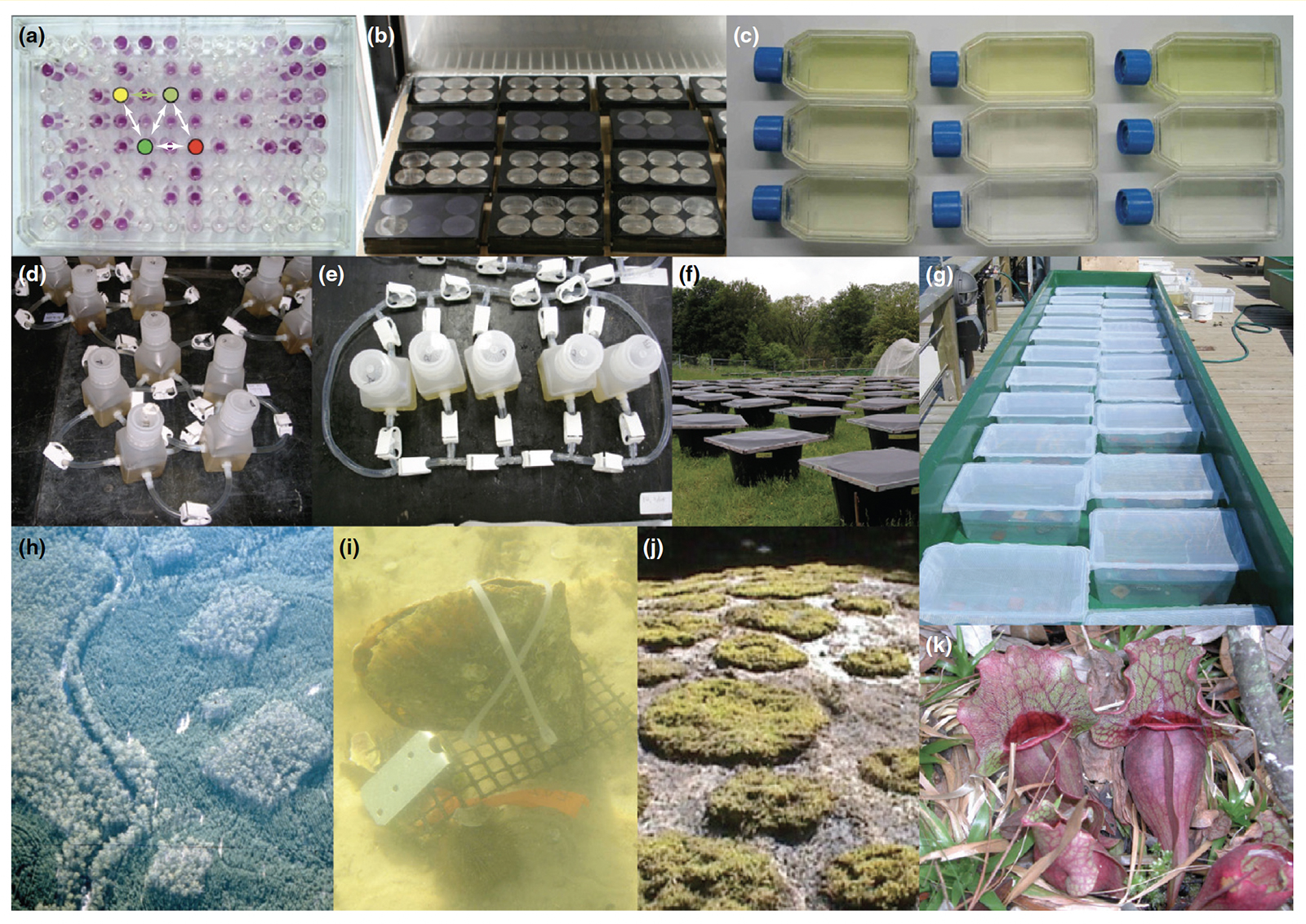
Figure from Logue et al. 2011
Experimental approaches to metacommunities. (a) Bacterial metacommunities in a 96-well plate; wells containing different carbon sources. (b) Algal metacommunities in 6-well plates; wells receiving different degrees of shading. (c) Algal metacommunities in culture flasks differing in resource ratios. (d,e) Protist metacommunities in culture flasks connected via tubes allowing global dispersal (d) or including topology in dispersal (e). (f) Outdoor pond mesocosms. (g) Outdoor metacommunities of marine benthic invertebrates at the Tja" rno" Marine Biological Laboratory, Sweden. (h) Aerial photograph of a fragmentation experiment in a forested landscape. (i) Natural metacommunity within pen shells. (j) Moss patches on rocks used for fragmentation experiments. (k) Inquiline metacommunities in leaves of Sarracenia purpurea.
Full Article (PDF)