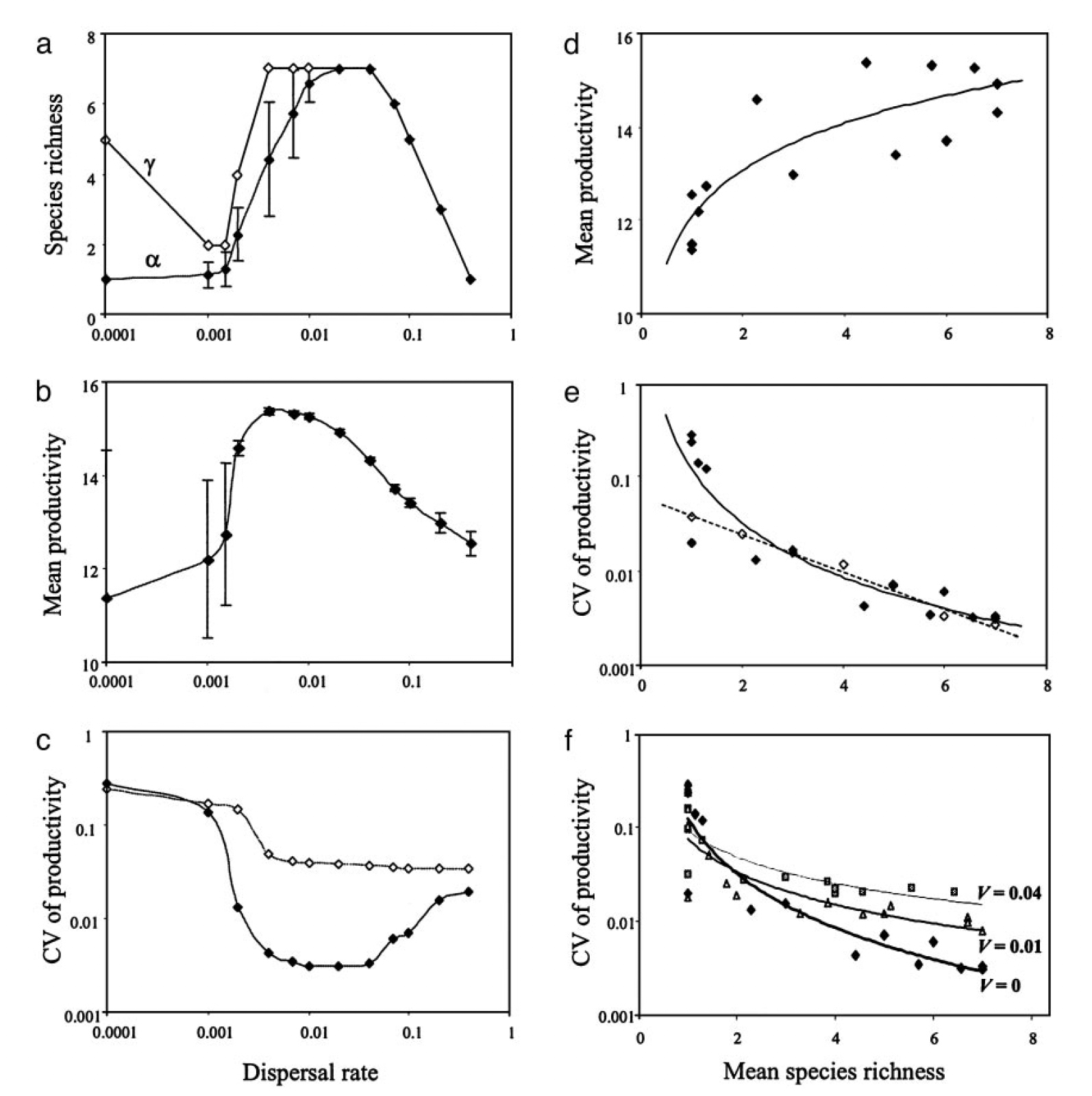
The potential consequences of biodiversity loss for ecosystem functioning and services at local scales have received considerable attention over the last decade, yet much less is known about how biodiversity influences ecosystem processes and stability across larger spatial scales. The authors propose that biodiversity can provide "spatial insurance" for ecosystem functioning through spatial exchanges among local systems within heterogeneous landscapes.
To investigate this idea, they use a theoretical metacommunity model that incorporates explicit local consumer-resource dynamics and dispersal among systems. The model demonstrates that dispersal rate strongly and nonlinearly influences both the temporal mean and variability of ecosystem productivity through two main mechanisms: spatial averaging by intermediate-type species that tend to dominate at high dispersal rates, and functional compensation among species enabled by the maintenance of species diversity.
Spatial insurance effects are strongest at intermediate dispersal rates, which also maximize local diversity. These findings have important implications for conservation and ecosystem management, highlighting the need to understand spatial ecological processes in order to predict how landscape changes may affect biodiversity, ecosystem functioning, and ecosystem services.