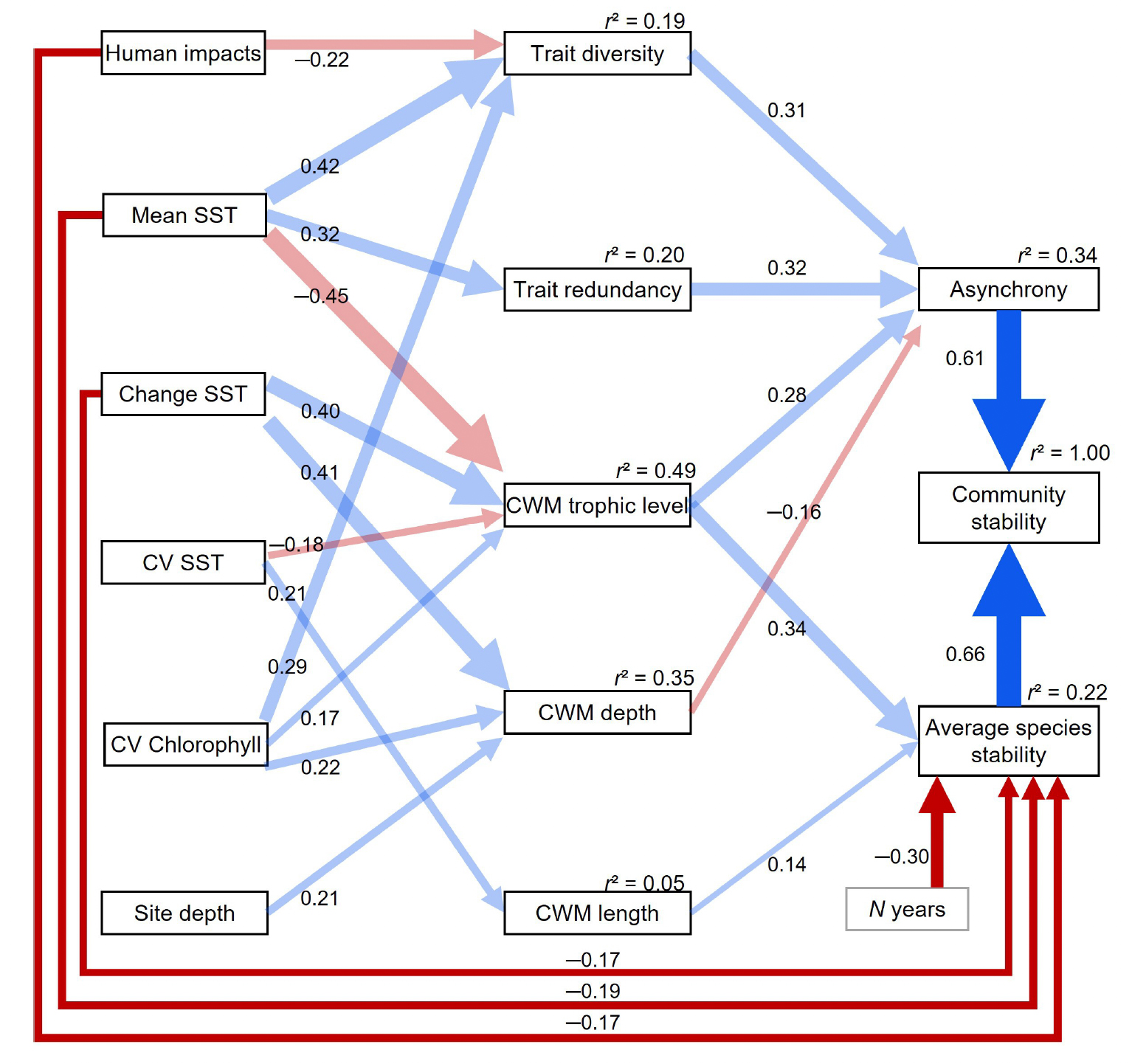
Here, we examine both direct and indirect, trait-mediated effects of environmental variability and human impacts on species biomass stability and asynchrony in 215 Australian shallow reefs. These communities span a 10 degree sea surface temperature (SST) gradient and have been monitored over 14 years.
Our results indicate higher asynchrony in tropical reefs owing to higher trait diversity and trait redundancy and higher species stability in colder, temperate communities owing to higher mean trophic level. Human impacts, through their negative effects on species stability and trait diversity, were the main destabilizing factor of fish community biomass.
Temporal change in SST destabilized species biomass while increasing mean trophic level in fish communities. Overall, our findings show that a comprehensive analysis of the multiple facets of functional diversity is crucial to better understand and forecast the long-term stability of marine ecosystems under global change.