Although it is well-known that dispersal of organisms within a metacommunity will influence patterns of coexistence and richness, theoretical and experimental studies generally assume that dispersal rates are constant through time. However, dispersal is often a highly variable process that can vary seasonally and/or when stochastic events (e.g. wind storms, droughts, floods) occur.
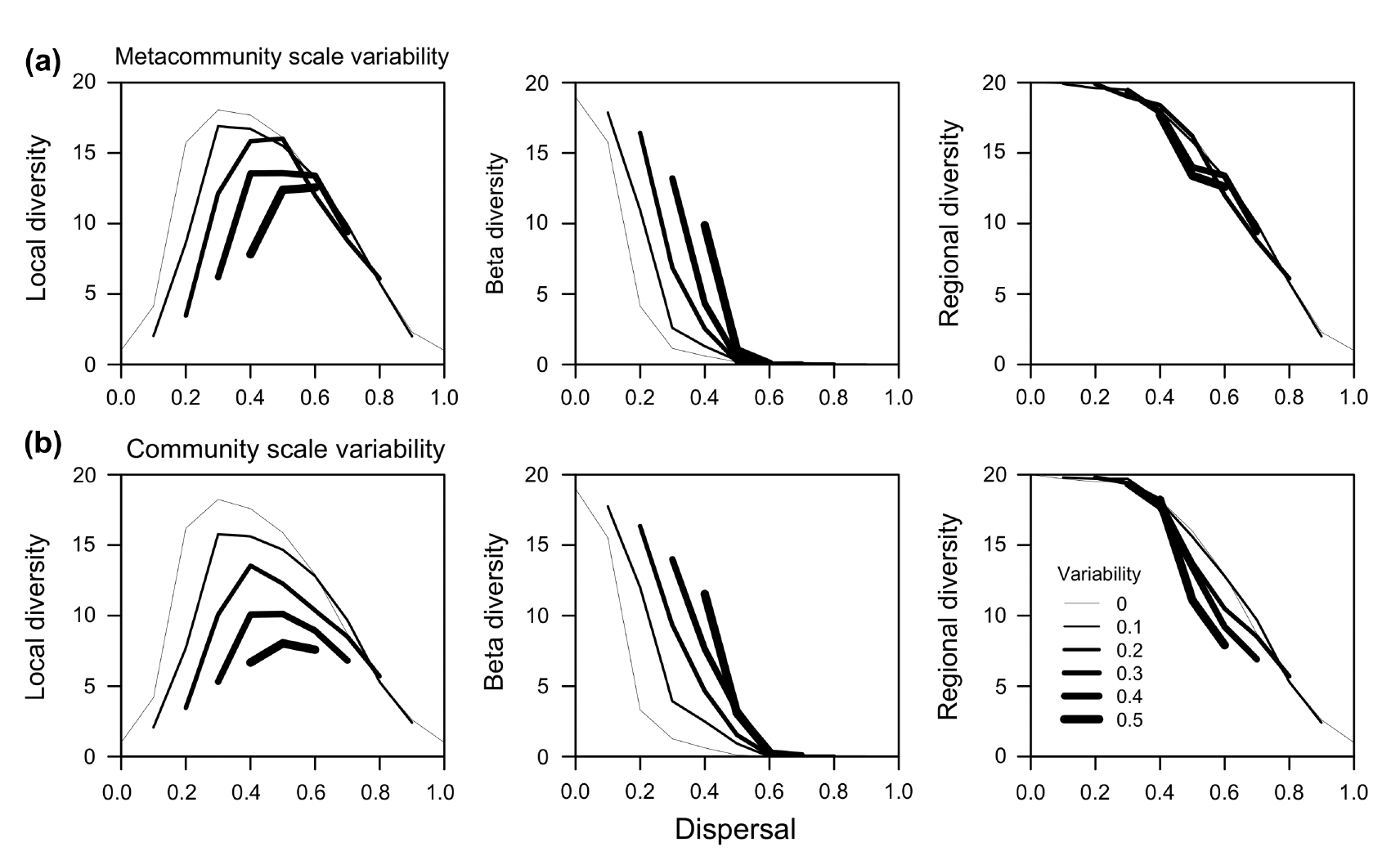
Using a well-known source-sink metacommunity model, we present novel predictions for local and regional species richness when stochasticity in dispersal is expressly considered. We demonstrate that dispersal stochasticity alters some of the predictions obtained with constant dispersal; the peak of the predicted hump-shaped relationship between dispersal and local species richness is diminished and shifted towards higher values of dispersal.
Dispersal stochasticity increases extinction probabilities of inferior competitor species particularly in metacommunities subjected to severe isolation events (i.e. decreases of dispersal) or homogenization events (i.e. sudden increases of dispersal). Our results emphasize how incorporating dispersal stochasticity into theoretical predictions will broaden our understanding of metacommunities dynamics and their responses to natural and human-related disturbances.