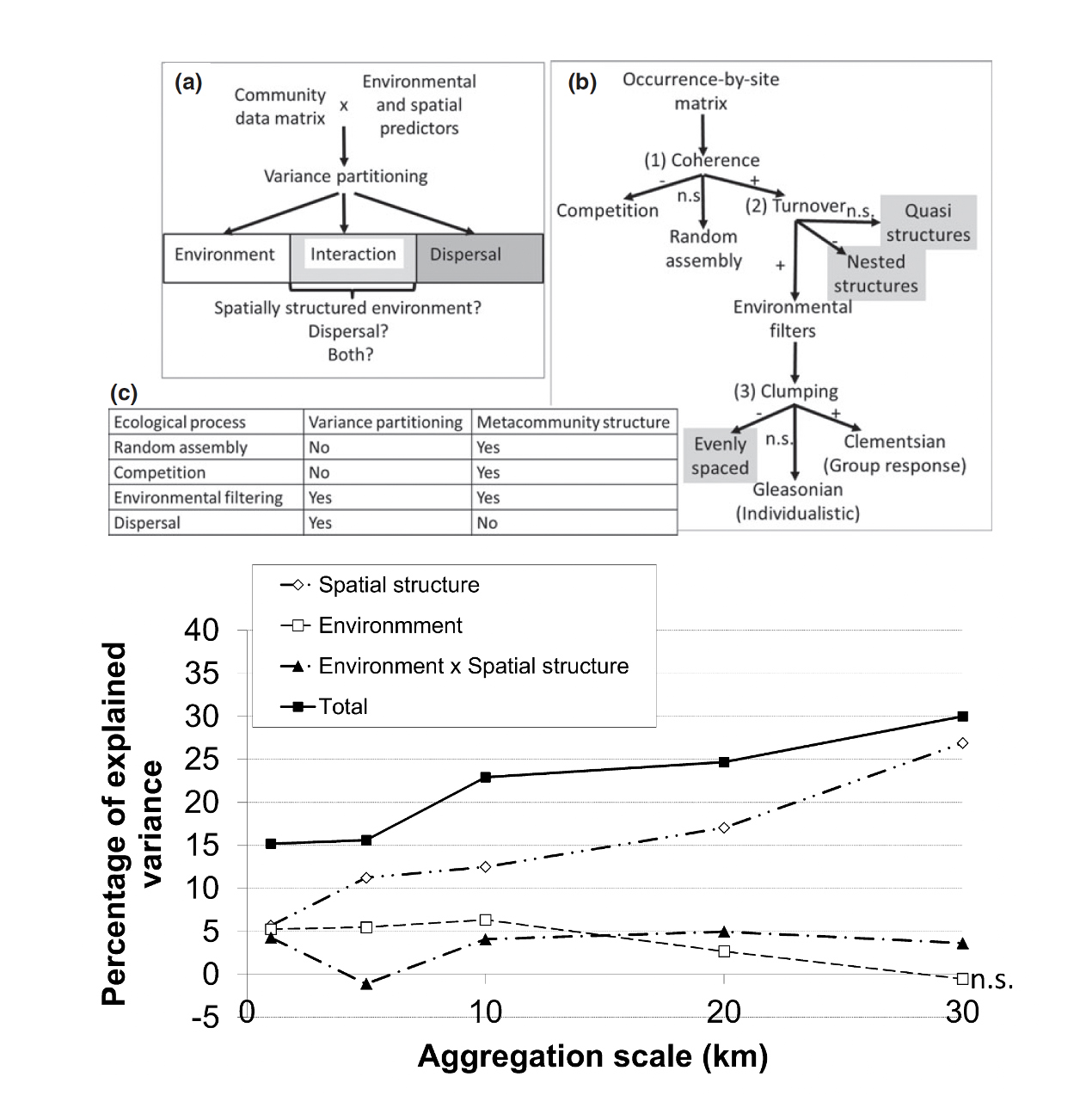
Aim : Metacommunity theories attribute different relative degrees of importance to dispersal, environmental filtering, biotic interactions and stochastic processes in community assembly, but the role of spatial scale remains uncertain. Here we used two complementary statistical tools to test: (1) whether or not the patterns of community structure and environmental influences are consistent across resolutions; and (2) whether and how the joint use of two fundamentally different statistical approaches provides a complementary interpretation of results. Location : Grassland plants in the French Alps. Methods We used two approaches across five spatial resolutions (ranging from 1 km 9 1 km to 30 km 9 30 km): variance partitioning, and analysis of metacommunity structure on the site-by-species incidence matrices.
Both methods allow the testing of expected patterns resulting from environmental filtering, but variance partitioning allows the role of dispersal and environmental gradients to be studied, while analysis of the site-by-species metacommunity structure informs an understanding of how environmental filtering occurs and whether or not patterns differ from chance expectation. We also used spatial regressions on species richness to identify relevant environmental factors at each scale and to link results from the two approaches. Results : Major environmental drivers of richness included growing degree-days, temperature, moisture and spatial or temporal heterogeneity.
Variance partitioning pointed to an increase in the role of dispersal at coarser resolutions, while metacommunity structure analysis pointed to environmental filtering having an important role at all resolutions through a Clementsian assembly process (i.e. groups of species having similar range boundaries and co-occurring in similar environments). Main conclusions : The combination of methods used here allows a better understanding of the forces structuring ecological communities than either one of them used separately. A key aspect in this complementarity is that variance partitioning can detect effects of dispersal whereas metacommunity structure analysis cannot. Moreover, the latter can distinguish between different forms of environmental filtering (e.g. individualistic versus group species responses to environmental gradients).