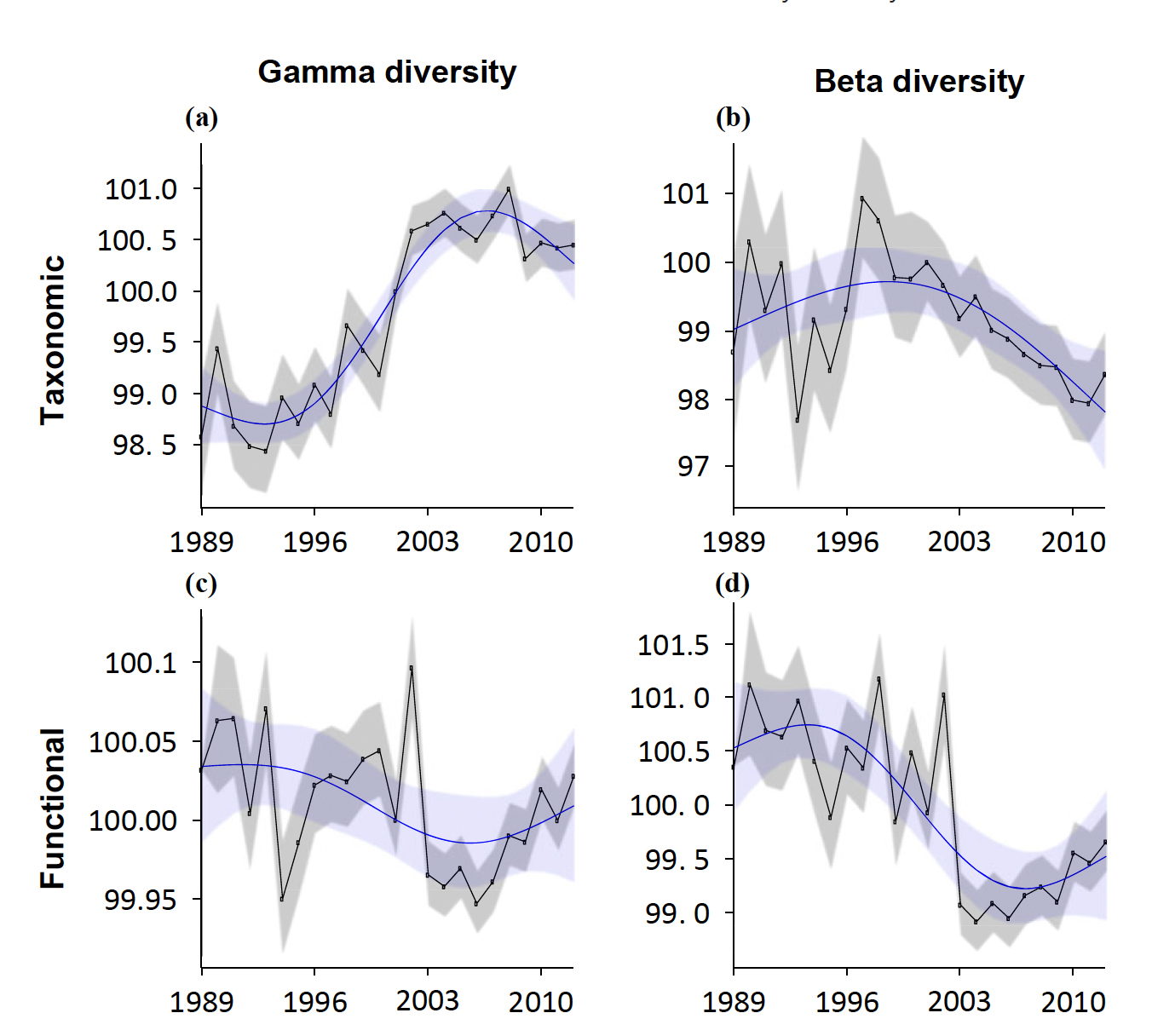
We assessed the temporal trends of taxonomic, functional and phylogenetic diversities in the French avifauna over the last two decades. We analysed a large-scale dataset that recorded annual changes in the abundance of 116 breeding birds in France between 1989 and 2012. We decomposed and analysed the spatio-temporal dynamics of taxonomic, phylogenetic and functional diversities and each of their I+/--, I^2- and I^3-components.
We found large variation within and among the temporal trends of each biodiversity facet. On average, we found a marked increase in species and phylogenetic diversity over the period considered, but no particular trend was found for functional diversity.
We also found a general increase in the local occurrence and abundance of generalist species within local communities. These results highlight a relative asynchrony of the different biodiversity facets occurring at large spatial scales. We show why a multifaceted approach to biodiversity dynamics is needed to better describe and understand changes in community composition in macroecology and conservation biogeography.