Oikos · 2001

Coexistence, saturation and invasion resistance in simulated plant assemblages

Moore J.L., Mouquet N., Lawton J.H., Loreau M.

doi.org/10.1034/j.1600-0706.2001.940211.x
Download PDF
Scroll down for preview

Key Message

Here, we simulate plant community assembly using four models that have different underlying coexistence mechanisms (and so differ in the amount of available niche space) and subject them to invasion. We created species richness gradients by comparing between models or by considering the output of a single model with different parameter values.

We found that the relation between species richness and invasion resistance depends critically on the model considered and the cause of the species richness gradient. Overall, our results suggest that species richness does not necessarily correlate with saturation and is likely to be a poor predictor of invasion resistance.

These results provide a possible explanation for the variety of outcomes reported in recent experimental and observational studies that examine the relationship between species richness and invasion resistance. We conclude that consideration of the processes regulating species richness is crucial for a successful understanding of invasion resistance along species richness gradients.
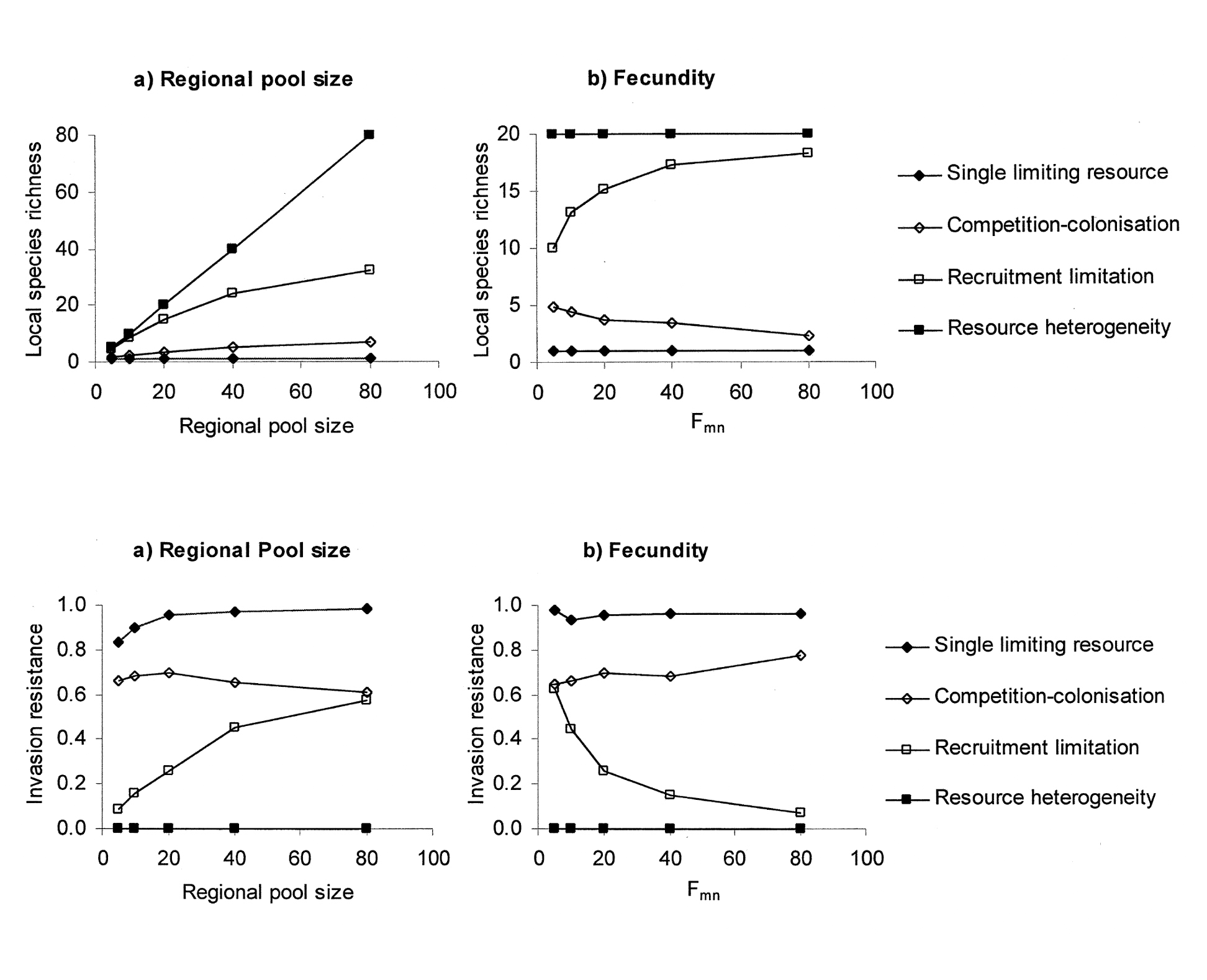
Figure from Moore et al. 2001
Up : Effect of the initial size of the regional species pool and changes in the fecundity parameter (F_mn) on the resulting species richness of assemblages under four different coexistence mechanisms. Each point represents the mean value obtained from 50 simulations. Error bars representing one standard error are omitted because they are smaller than the symbols in all cases (all standard errors < 0.25). Below: Effect of the initial size of the regional species pool and changes in the fecundity parameter (F_mn) on the invasion resistance of assemblages under four different coexistence mechanisms. Invasion resistance is calculated as 1 - the proportion of successful invasions. Each point represents the mean value from 50 simulations. Error bars representing one standard error are omitted because they are smaller than the symbols in all cases (all standard errors < 0.05).
Full Article (PDF)