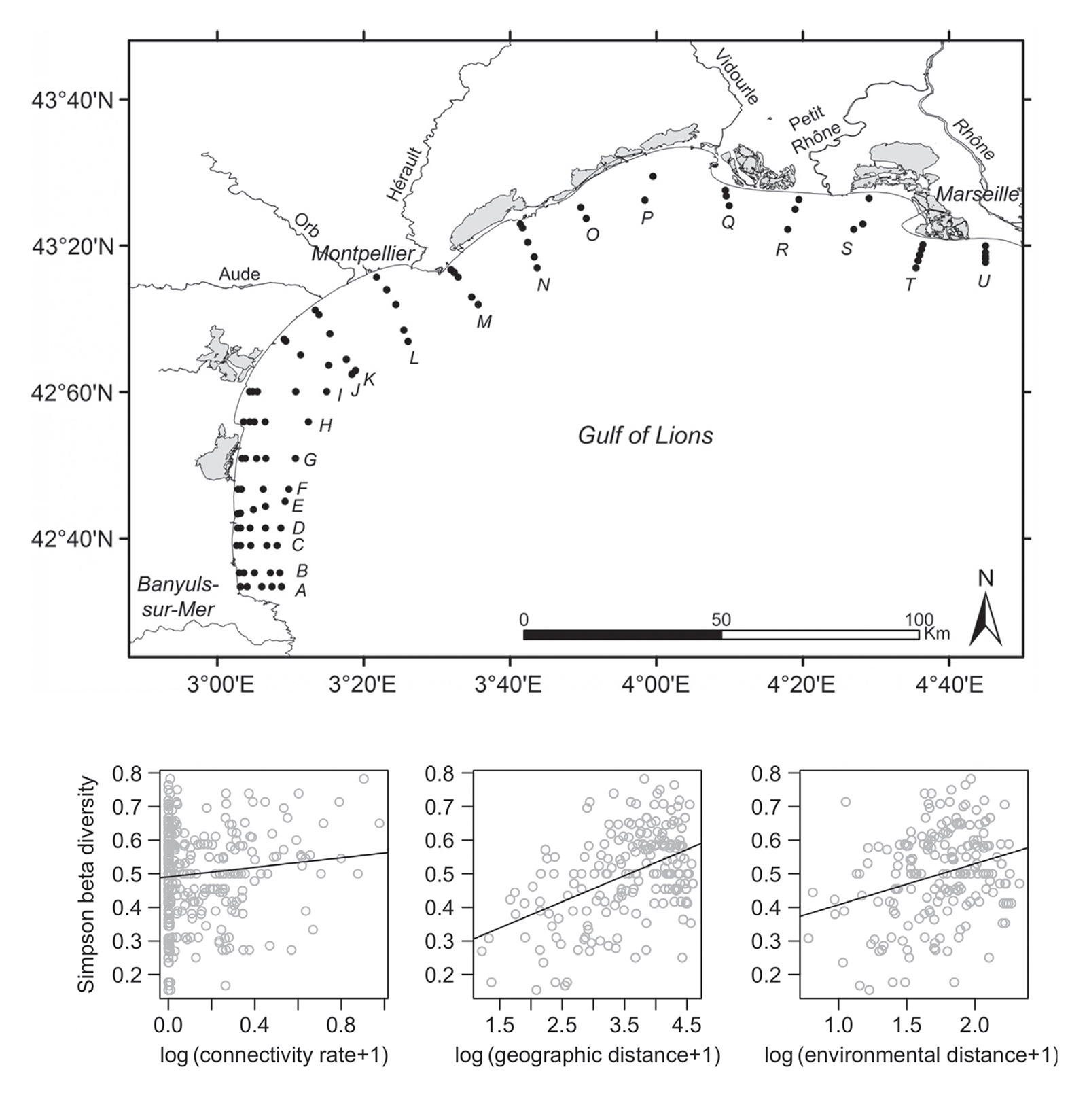
Dispersal is a key process in metacommunity dynamics, allowing the maintenance of diversity in complex community networks. Geographic distance is usually used as a surrogate for connectivity implying that communities that are closely located are considered more prone to exchange individuals than distant communities. However, in some natural systems, organisms may be subjected to directional dispersal (air or water fl ows, particular landscape confi guration), possibly leading close communities to be isolated from each other and distant communities to be connected.
Using geographic distance as a proxy for realised connectivity may then yield misleading results regarding the role of dispersal in structuring communities in such systems. Here, we quantifi ed the relative importance of fl ow connectivity, geographic distance, and environmental gradients to explain polychaete metacommunity structure along the coasts of the Gulf of Lions (northwest Mediterranean Sea).
Flow connectivity was estimated by Lagrangian particle dispersal simulations. Our results revealed that this metacommunity is strongly structured by the environment at large spatial scales, and that both fl ow connectivity and geographic distance play an important role within homogeneous environments at smaller spatial scales. We thus strongly advocate for a wider use of connectivity measures, in addition to geographic distance, to study spatial patterns of biological diversity (e.g. distance decay) and to infer the processes behind these patterns at diff erent spatial scales.