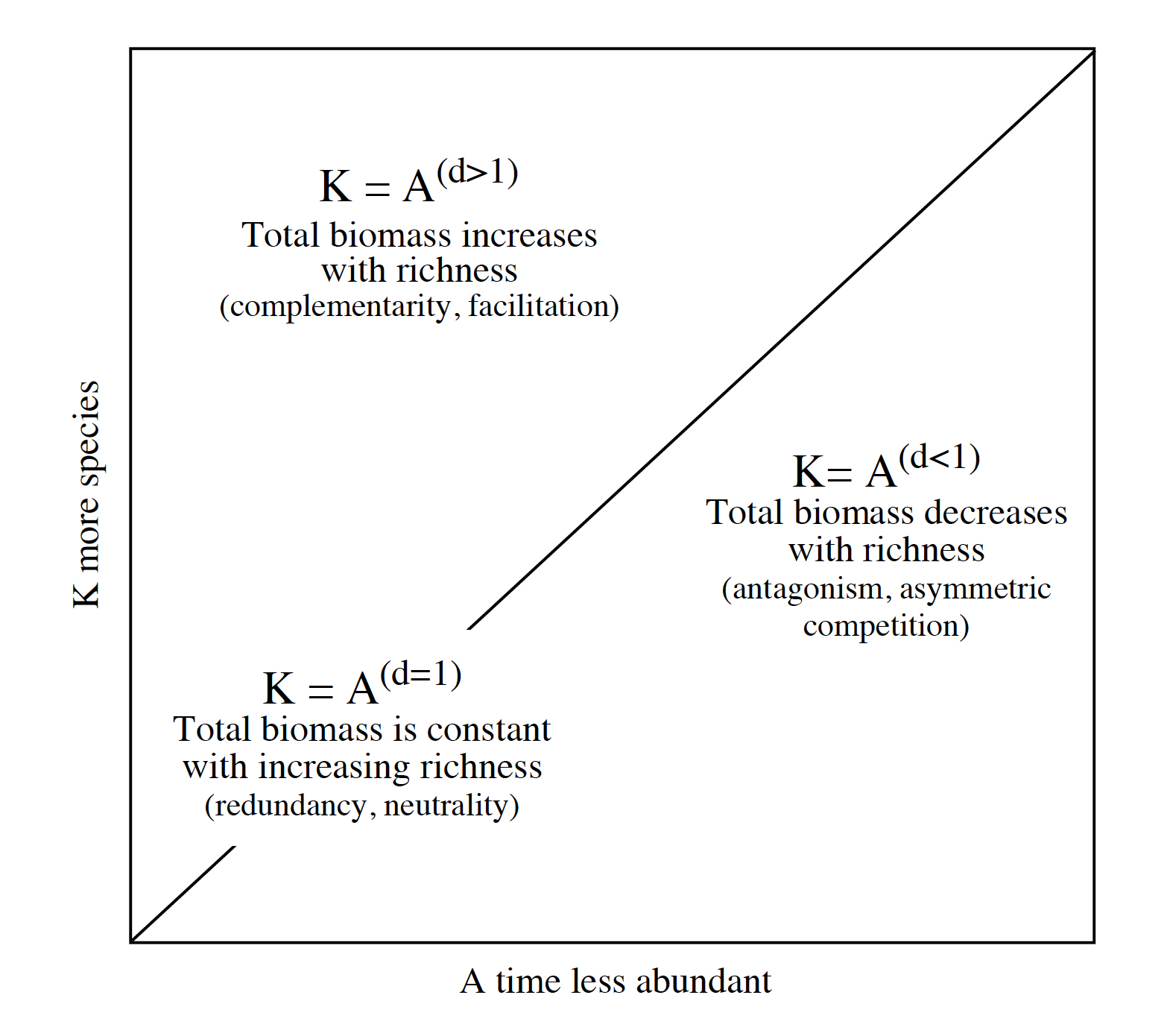
The mechanisms that promote species richness, including net community interactions, are considered central to the investigation of the consequences of biodiversity loss for ecosystem functioning. Recently, some empirical studies at large spatiotemporal scales suggest that increasing species richness within natural communities results in a finer division of biomass among species rather than an increase in total biomass.
In parallel, the most common pattern observed in nature is the peaked relationship between diversity and productivity estimated as total biomass. Thus, the aim of our study is to provide model predictions for the diversity-biomass relationship with various levels of net species interactions within communities: negative, neutral, quasi-neutral and positive. Using a scaling relationship between the number of species and total community biomass, we propose a new self-similar process of biomass partitioning during a community assembly process.
At each step of the succession, K more species appear that are A times less abundant on average giving K=A^d the parameter d being a fractal dimension related to the nature of interactions among coexisting species. Our results, compared to those from meta-analyses about empirical diversity–productivity relationships, illustrate that quasi-neutral interactions among coexisting species lead to the most commonly observed pattern: an envelope where diversity peaks at intermediate values of total biomass, i.e. that the area below the hump-backed line (considered as the upper boundary) is filled with data points.