Species richness has historically been studied with a separation between small and large scale processes. Species diversity has been approached, on the one hand, from a local perspective, based on niche theory, and on the other hand, from a regional perspective, through island biogeography, with no strong interactions between these two levels. In this article, we go further and study a network of communities linked by dispersal, in which each community acts as a source of immigrants for other communities in the region.
Thus, immigration becomes an explicit function of emigration from other communities. Such a network is called a Metacommunity. We describe the environmental conditions and constraints on species parameters that promote coexistence in such a system.
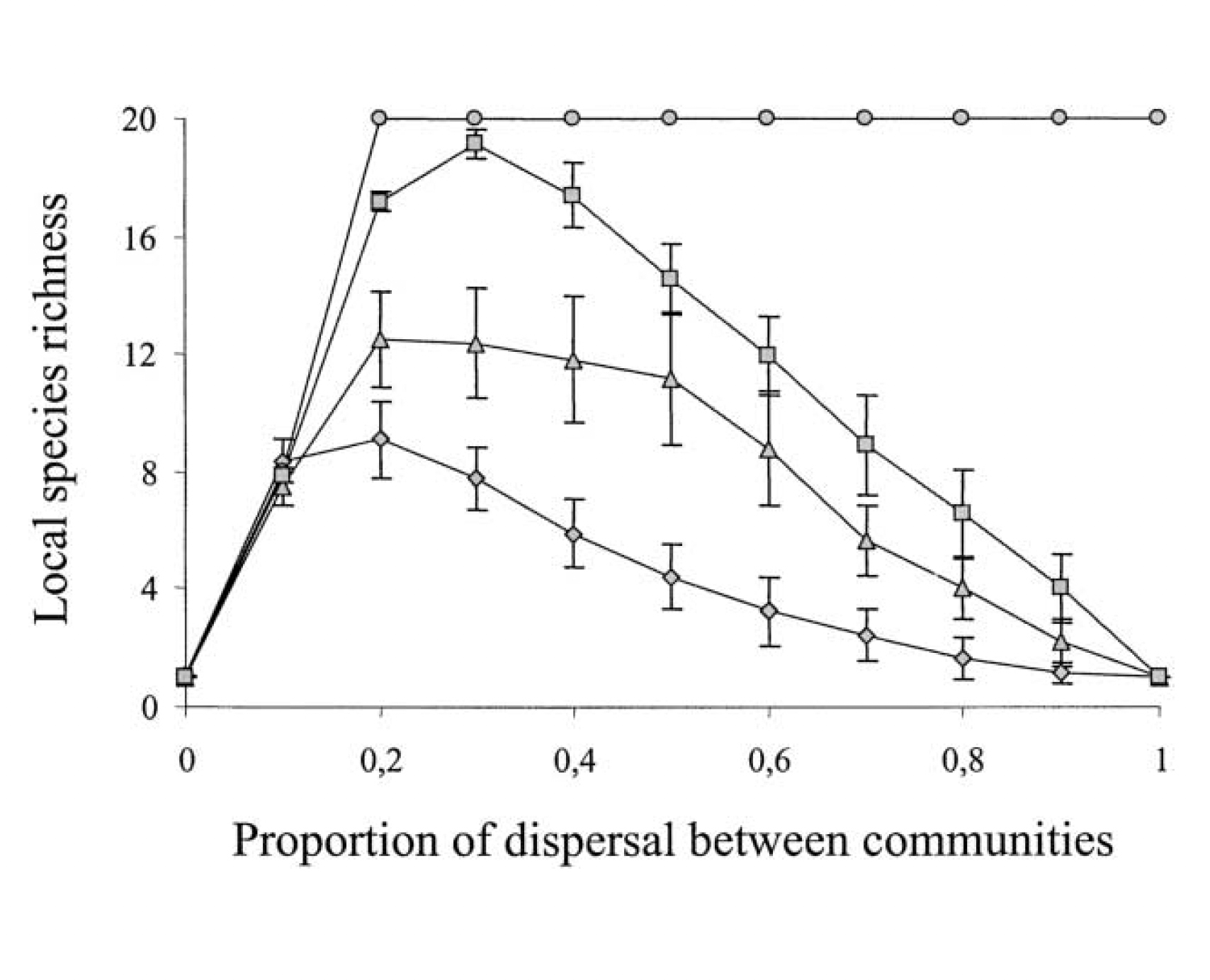
Finally, we investigate the dynamics of species diversity depending on the relative importance of dispersal between communities. Our approach potentially concerns any ecological system in which the dispersal dynamics leads to a spatial structure that permits a distinction between local and a regional dynamics. However, for simplicity we describe our model in terms that concern sessile organisms such as plants.