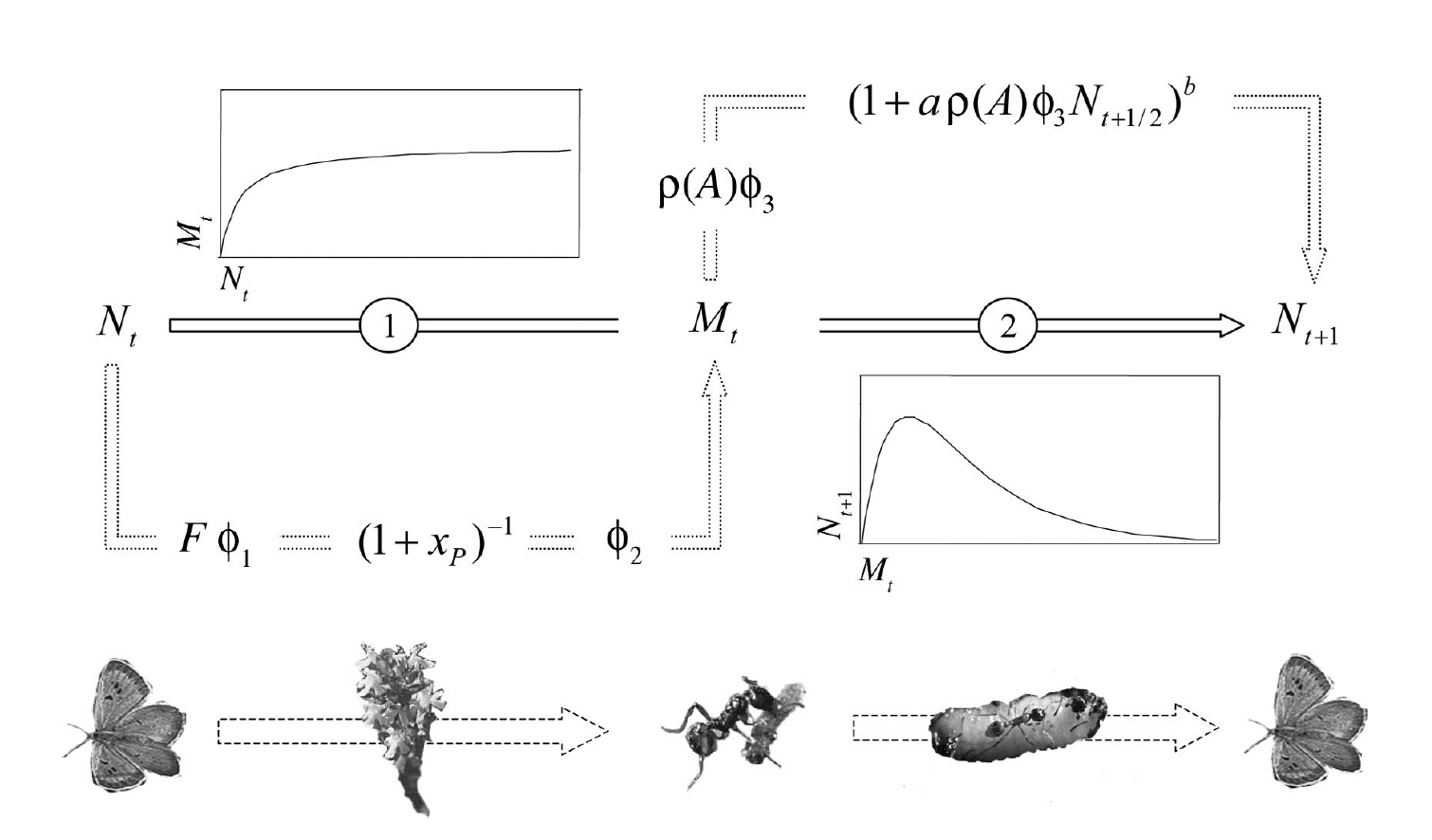
The butterfly Maculinea alcon and its host plant Gentiana pneumonanthe have long been used as indicators of high-quality Palearctic heath and moist grassland ecosystems, and both species have been targeted for ecological research and specific conservation management. We constructed a mechanistic model of this community module, including dynamics for the three species, and conducted simulation studies of different conservation strategies (burning, sod cutting, mowing, and grazing).
We identified several key parameters for the conservation of Maculinea alcon and its host plant as well as the most efficient conservation strategies for their dual long-term persistence. Our results show that the conditions that optimize the size of the butterfly and the plant populations differ, suggesting that choices must be made in adopting conservation measures. Despite the potential for apparent competition between the ant, Myrmica scabrinodis, and the plant via the butterfly, realized apparent competition is asymmetric (ants are more affected than plants) and occurs only at intermediate successional stages.
Our study provides an example whereby an endangered species (the plant) and its endangered specialist natural enemy (the butterfly) are adversely affected by successional dynamics via direct (for the plant) and indirect (for the butterfly) effects. We argue that different field situations will necessitate particular conservation solutions.