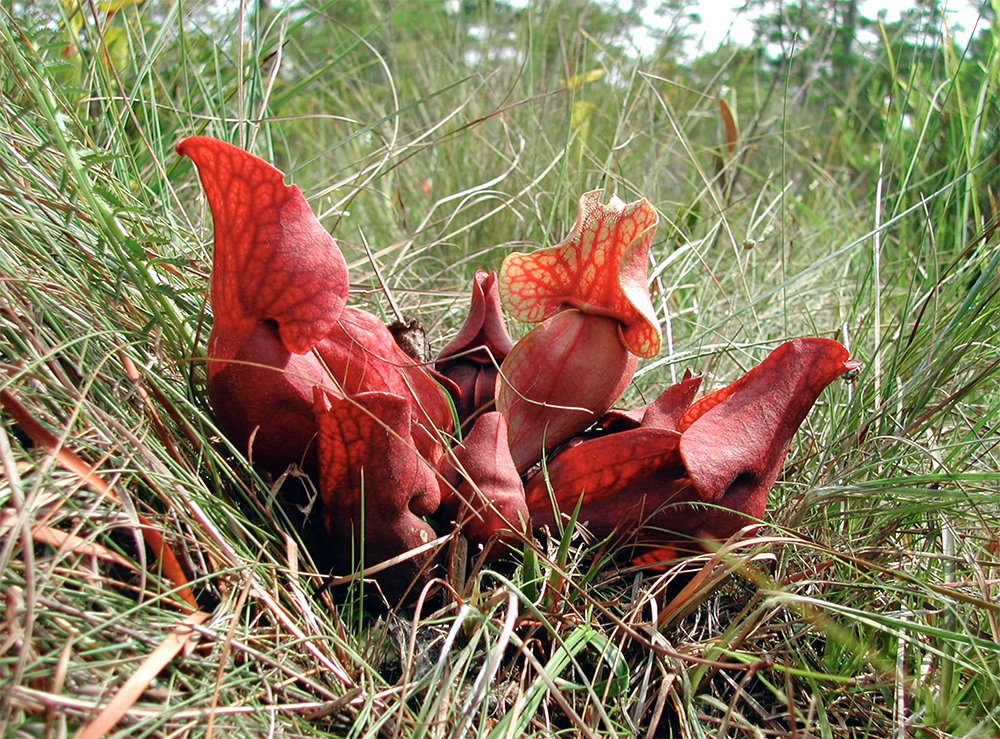
To improve our understanding of the relationship between the pitcher plant Sarracenia purpurea and the phytotelma community inhabiting its leaves, we developed an exploratory mechanistic model based on stoichiometric constraints on carbon and nitrogen during prey decomposition. Our results suggest that the phytotelma community functions as a mineralizing system supplying nitrogen to the plant, a conclusion supported by field and literature data showing prey decomposition provides a major nitrogen source.
The model predicts that nitrogen yield is greater when only bacteria are present than when the full food web is included: bacterivores such as rotifers and protozoa reduce nitrogen availability, whereas mosquito larvae increase it through cascading effects.
At high sedimentation rates, mosquitoes positively influence nitrogen production by limiting nitrogen loss through sedimentation more than they export through pupation; at low sedimentation rates, the relationship between mosquito predation on bacterivores and nitrogen yield becomes hump-shaped. Overall, plant-bacteria and plant-mosquito interactions appear predominantly mutualistic, while plant-bacterivore interactions are mainly parasitic, illustrating how ecosystem properties such as nitrogen production emerge from trophic complexity and community-level selection.