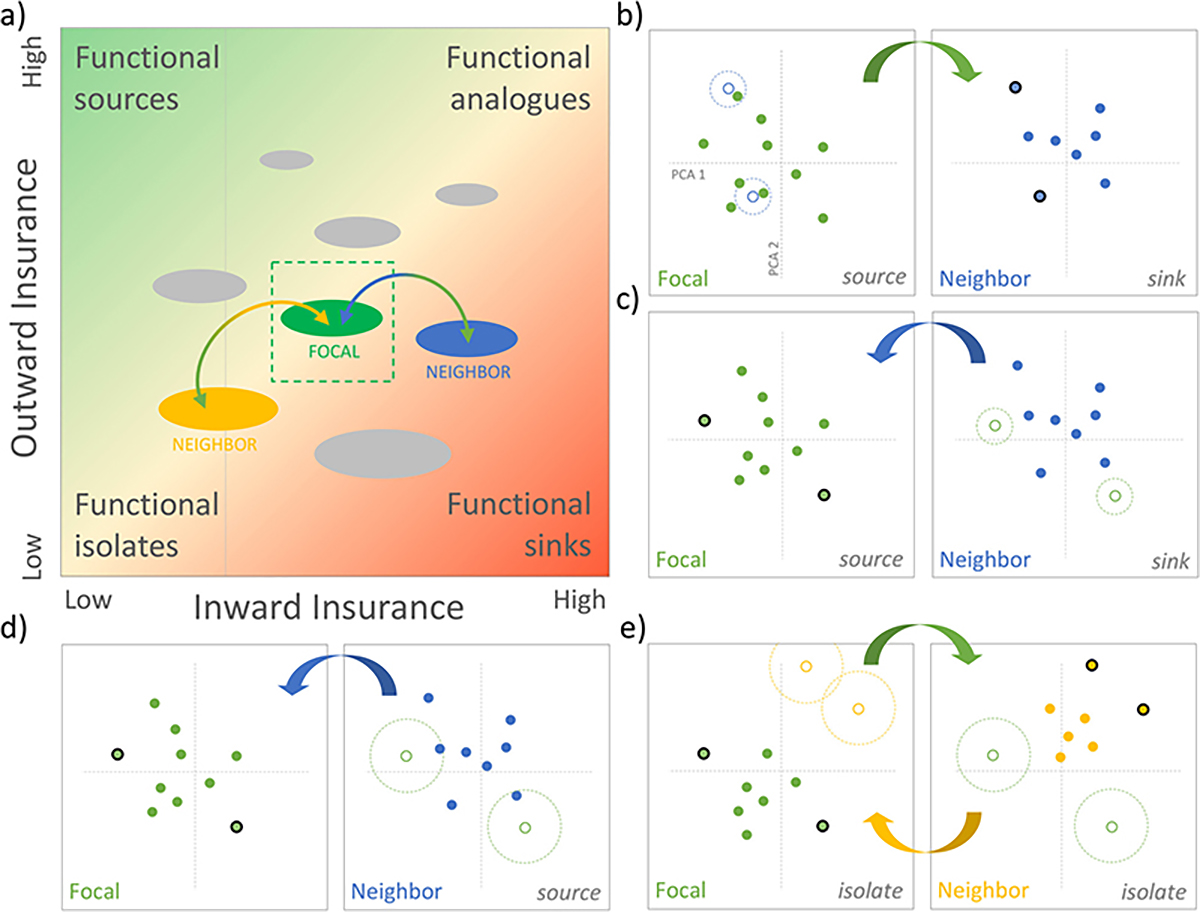
Biodiversity can buffer ecosystem functioning against disturbances by allowing species to compensate for functions lost through extirpation, a process known as ecological insurance. Functional ecology extends this idea by highlighting trait redundancy among species that helps maintain core ecosystem functions.
However, some functions may rely on species with unique trait combinations that are less likely to be redundant within local communities. Here, we introduce a broadly applicable framework to quantify the spatial insurance provided by locally functionally distinct species across communities. It identifies how communities can act as functional sources (providing insurance) or sinks (depending on neighbours), a relationship not captured by traditional functional beta diversity metrics.
We apply this framework at large spatial scales for plants and birds, revealing biogeographic patterns of functional sources and sinks. This approach highlights functional vulnerability, for example bird communities where functional sources are disproportionately affected by human activities, and helps identify regions with differing resilience to environmental change, supporting conservation strategies based on spatial trait distributions rather than local biodiversity alone.