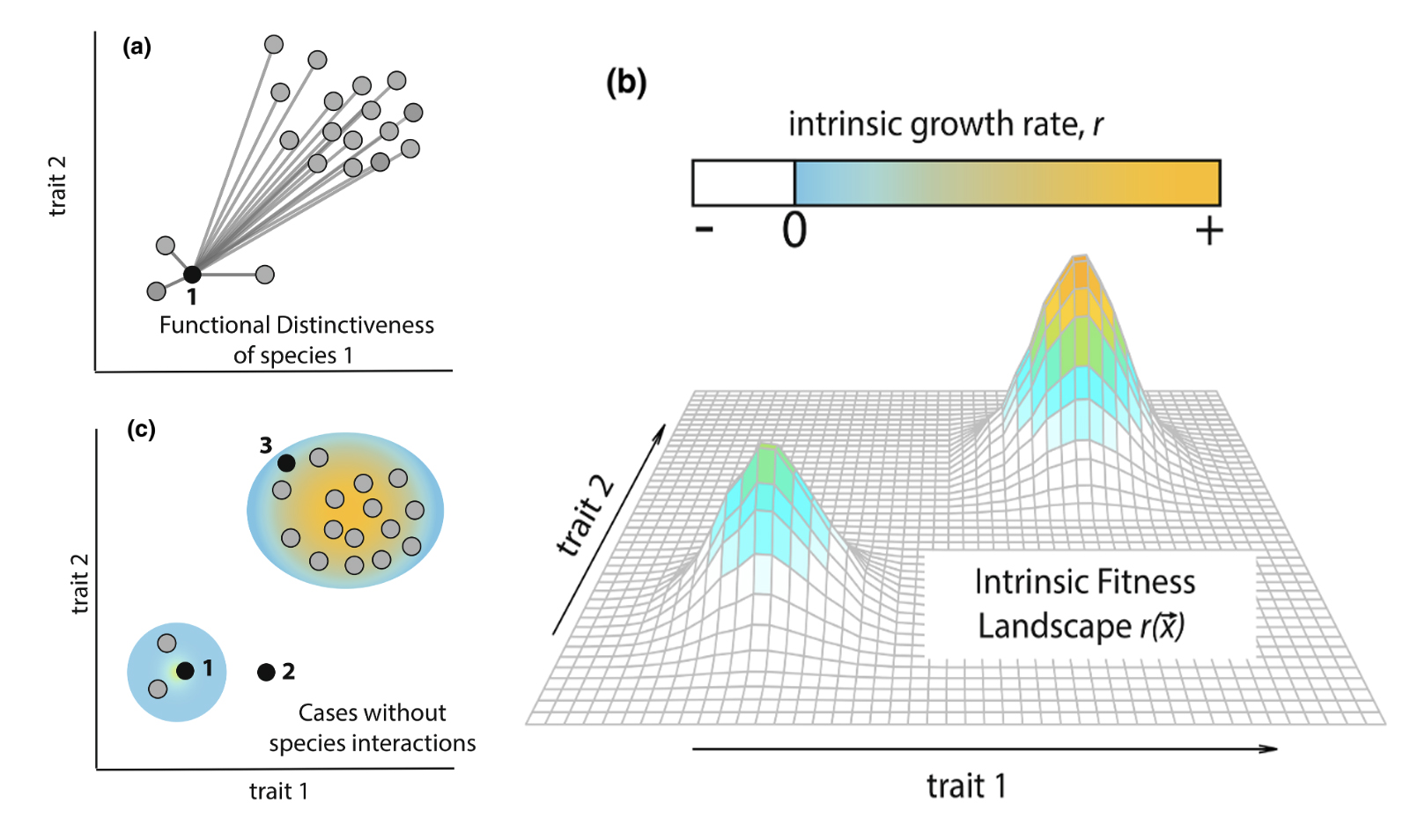
Recent work highlights functional trait distinctiveness, the average trait distance of a species from others in a community, as a key indicator of biodiversity and ecosystem functioning, yet its underlying mechanisms remain unclear. Here, we address this by considering a heterogeneous fitness landscape, where peaks represent trait combinations supporting positive population growth.
We identify four main processes explaining the emergence and persistence of functionally distinct species: environmental heterogeneity or alternative phenotypes promoting growth, sink populations deviating from local fitness peaks, species persisting at the margins of the fitness landscape, and biotic interactions reshaping that landscape.
We provide examples and guidelines to distinguish these cases, and show that stochastic dispersal limitation can also generate functional distinctiveness. This framework links fitness landscape heterogeneity to the functional structure of ecological communities.
Influence of abiotic environment on functional distinctiveness through the intrinsic fitness landscape. Functional distinctiveness is defined as the mean trait distance between a species and others in the community (a). The intrinsic fitness landscape describes how growth rates vary with traits, with peaks indicating positive growth (r > 0) (b). Together, these show that species can be functionally distinct for different reasons within the same community (c): occupying separate fitness peaks, persisting as sink populations, or occurring at the margins of a main fitness peak.