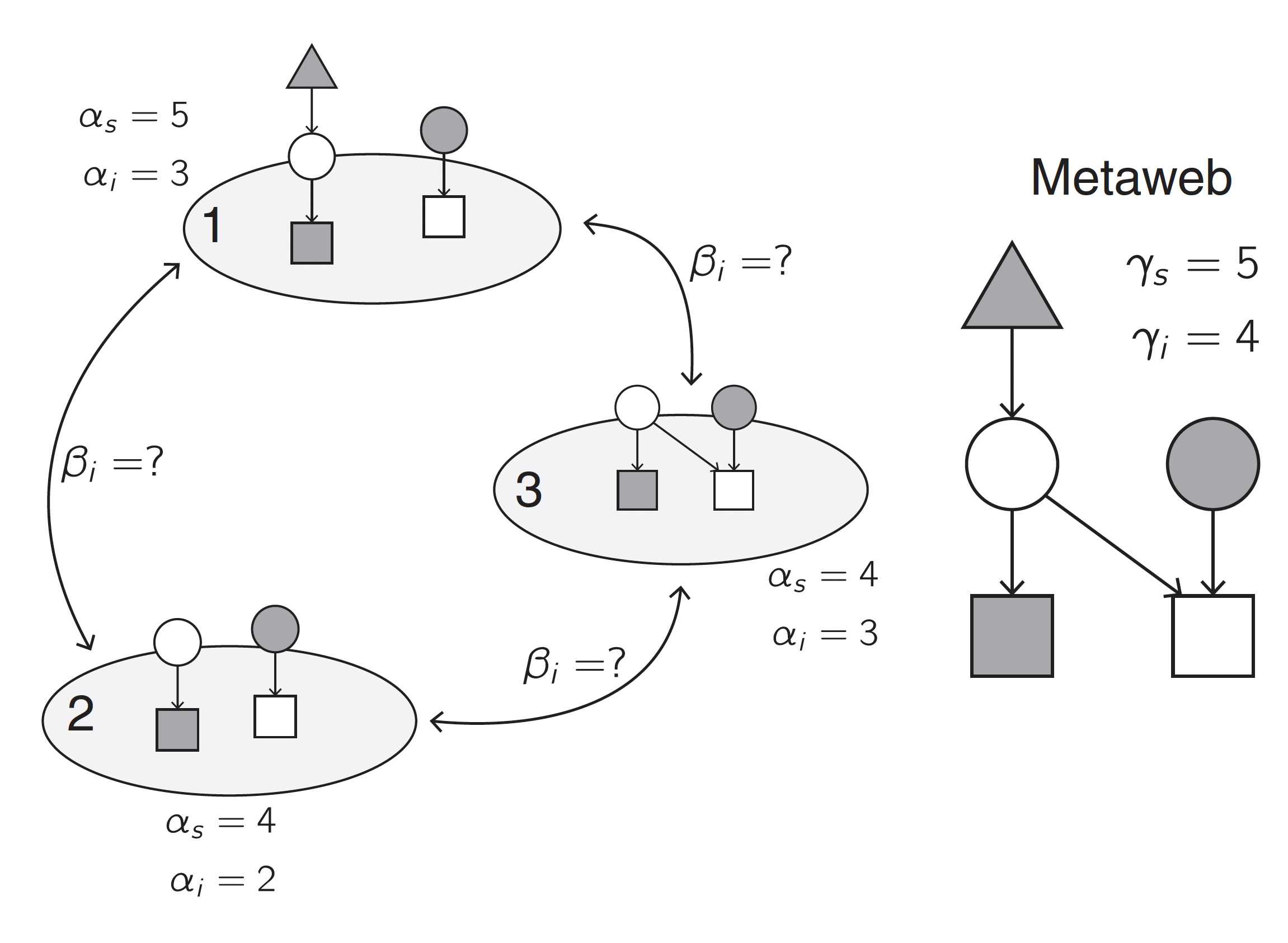
In a context of global changes, and amidst the perpetual modification of community structure undergone by most natural ecosystems, it is more important than ever to understand how species interactions vary through space and time. The integration of biogeography and network theory will yield important results and further our understanding of species interactions. It has, however, been hampered so far by the difficulty to quantify variation among interaction networks.
Here, we propose a general framework to study the dissimilarity of species interaction networks over time, space or environments, allowing both the use of quantitative and qualitative data. We decompose network dissimilarity into interactions and species turnover components, so that it is immediately comparable to common measures of beta-diversity.
We emphasise that scaling up beta-diversity of community composition to the beta-diversity of interactions requires only a small methodological step, which we foresee will help empiricists adopt this method. We illustrate the framework with a large dataset of hosts and parasites interactions and highlight other possible usages. We discuss a research agenda towards a biogeographical theory of species interactions.