Ecological specialization is a unifying concept in the biological sciences. While there are reliable ways to characterize specificity at individual and community levels, the evaluation of population and species-level measures is lacking. There is a need for such assessments given that populations and species are the relevant scales for most ecological and evolutionary processes.
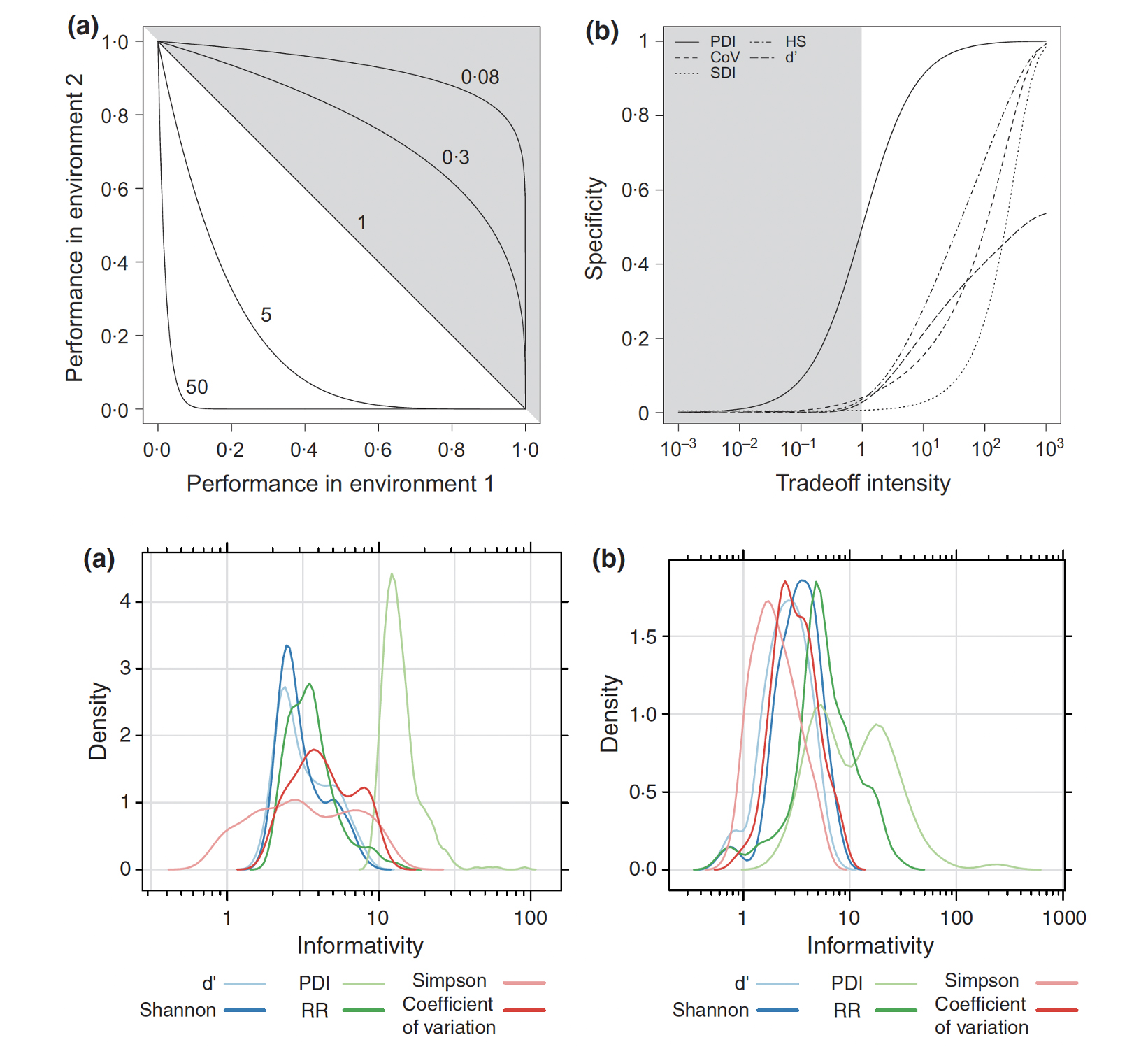
Using examples of simulated and empirical data sets of bipartite networks representing a continuum of biological interactions, we evaluate six indices of specialization in terms of their robustness to incomplete sampling and information they extract from data. Robustness differed between the measures and in their ability to differentiate specialists and generalists along a full continuum.
On the empirical data sets, indices were less separated by their informativity than on the simulated data sets, which may be due to the heterogeneity of the former. Based on these different evaluations for species-level (or population-level) specificity, we recommend the use of Resource range when no quantitative data are available and Paired Difference Index otherwise. These results will assist both applied and fundamental researchers in the characterization and interpretation of species specialization.