Ecology Letters · 2013

Trophic complementarity drives the biodiversity-ecosystem functioning relationship in food webs

Poisot T., Mouquet N., Gravel D.

doi.org/10.1111/ele.12118
Download PDF
Scroll down for preview

Key Message

The biodiversity-ecosystem functioning (BEF) relationship is central in community ecology. Its drivers in competitive systems (sampling effect and functional complementarity) are intuitive and elegant, but we lack an integrative understanding of these drivers in complex ecosystems.

Because networks encompass two key components of the BEF relationship (species richness and biomass flow), they provide a key to identify these drivers, assuming that we have a meaningful measure of functional complementarity. In a network, diversity can be defined by species richness, the number of trophic levels, but perhaps more importantly, the diversity of interactions. In this paper, we define the concept of trophic complementarity (TC), which emerges through exploitative and apparent competition processes, and study its contribution to ecosystem functioning.

Using a model of trophic community dynamics, we show that TC predicts various measures of ecosystem functioning, and generate a range of testable predictions. We find that, in addition to the number of species, the structure of their interactions needs to be accounted for to predict ecosystem productivity.
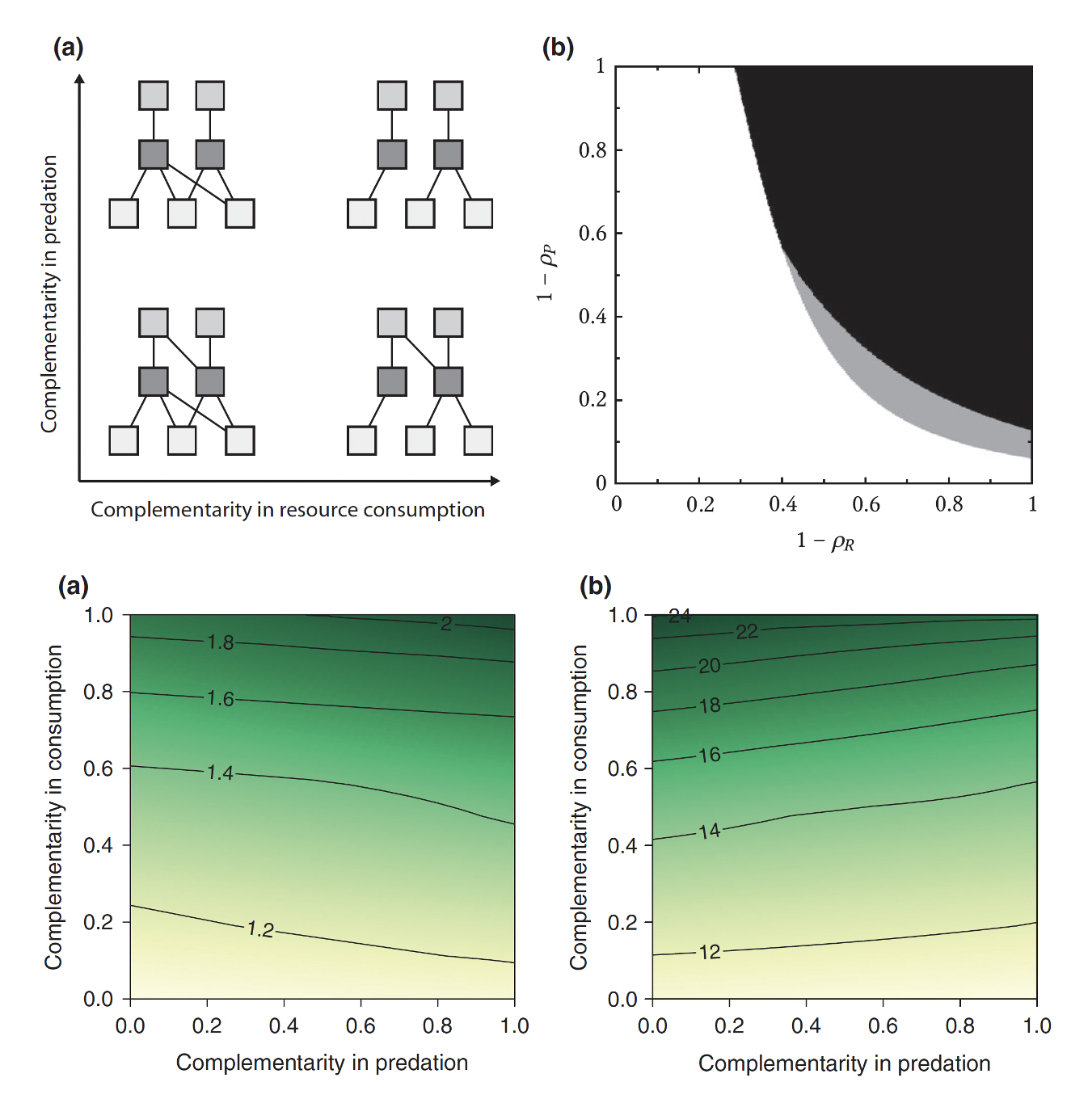
Figure from Poisot et al. 2013
Up: a) In a three-trophic-level system, similarity in resource or predator exploitation can be inferred from link distribution to and from the consumer level. Systems where few species share links are highly complementary. b) Analytical results from eq. 10 for a system with N = R = P = 2. Grey areas indicate coexistence without transgressive overyielding, and black areas coexistence with transgressive overyielding. Axes correspond to 1 - qR and 1 - qP, with increasing values indicating greater complementarity in consumption or predation. Down: Effects of varying complementarity (qR and qP) on transgressive overyielding and productivity. Greater complementarity in consumption and predation increased both overyielding and productivity. However, higher complementarity in predation strengthened overyielding while reducing equilibrium productivity at a fixed level of consumption complementarity. Lines and colours represent productivity isoclines.
Full Article (PDF)