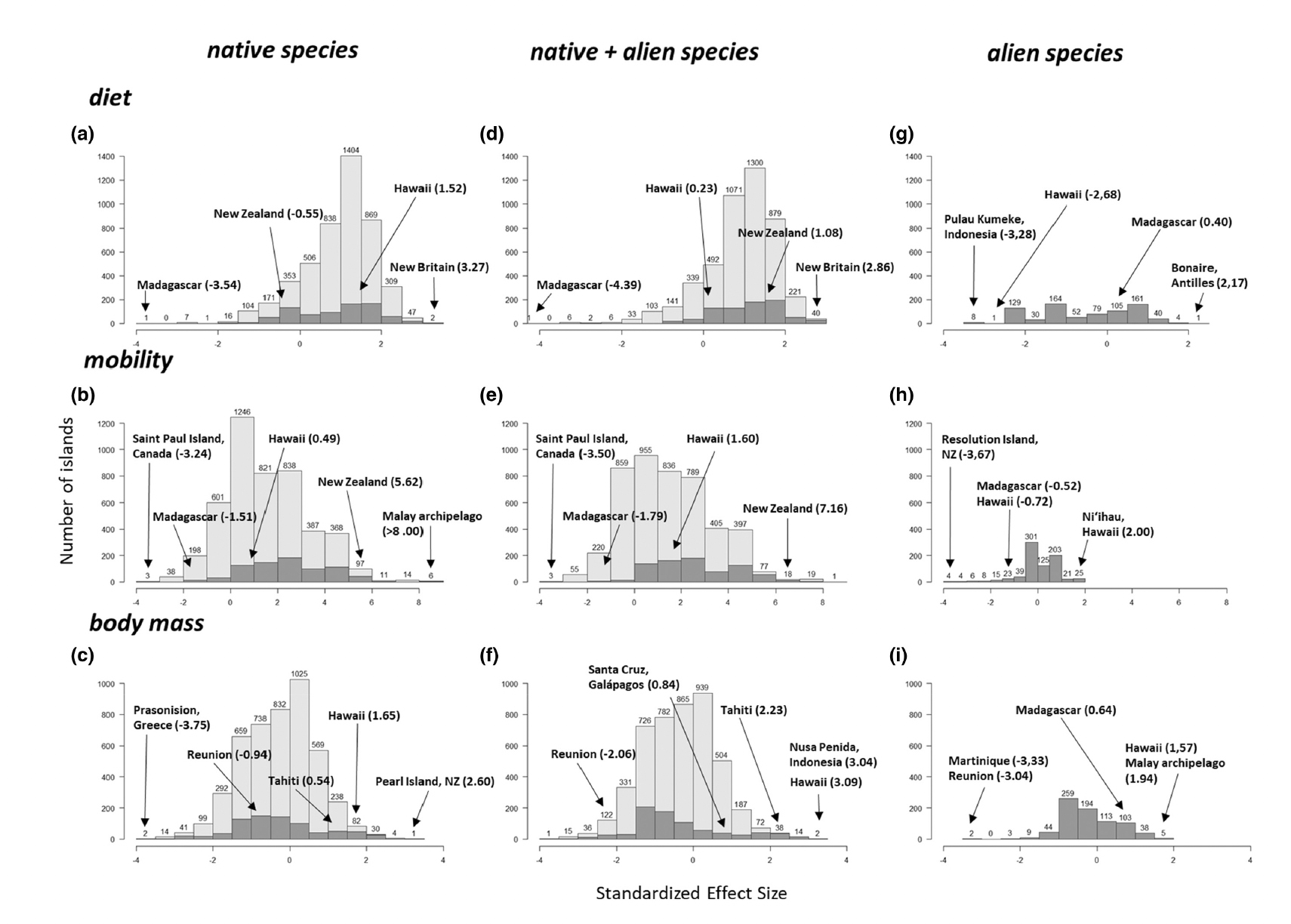
We investigates spatial variation in the ecological trait structure of breeding terrestrial bird assemblages across oceanic islands worldwide, testing whether native and naturalized alien species respond differently to environmental filters. Using distribution data for 3170 native and 169 alien species across 4660 islands, we analysed trait structure (diet, mobility, body mass) with null models and related patterns to environmental and human factors using spatial models.
Diet and mobility were generally more diverse than expected, while body mass was more clustered. Environmental variables explained trait patterns better than human impacts.
Invaded islands showed similar overall trait structures to non-invaded ones, though with more clustered body mass. Overall, alien species had limited influence on global trait patterns, likely due to their low representation or similarity to native species, with their distributions more strongly shaped by introduction conditions than by island constraints.