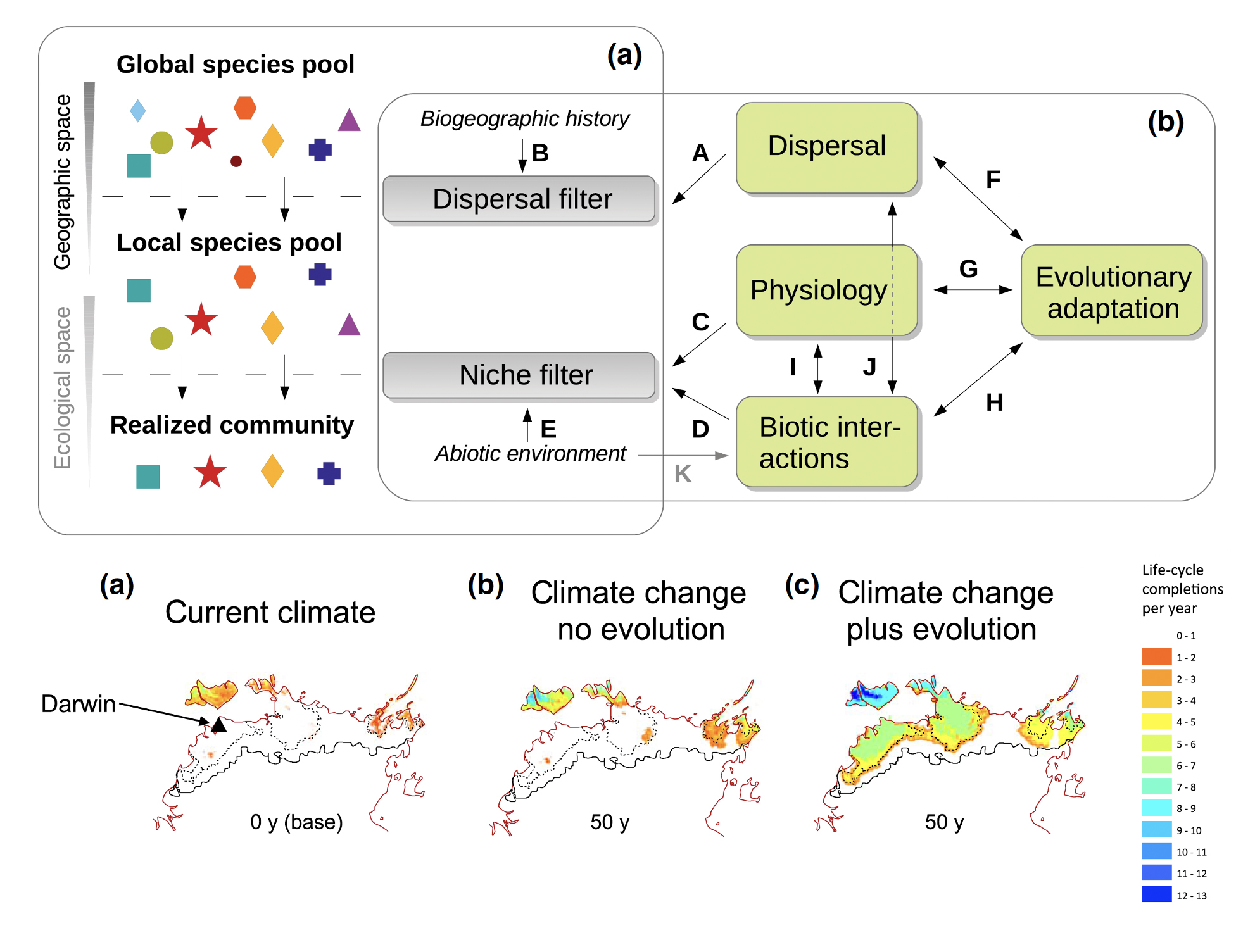
The demand for projections of the future distribution of biodiversity has triggered an upsurge in modelling at the crossroads between ecology and evolution. Despite the enthusiasm around these so-called biodiversity models, most approaches are still criticised for not integrating key processes known to shape species ranges and community structure. Developing an integrative modelling framework for biodiversity distribution promises to improve the reliability of predictions and to give a better understanding of the eco-evolutionary dynamics of species and communities under changing environments.
In this article, we briefly review some eco-evolutionary processes and interplays among them, which are essential to provide reliable projections of species distributions and community structure. We identify gaps in theory, quantitative knowledge and data availability hampering the development of an integrated modelling framework.
We argue that model development relying on a strong theoretical foundation is essential to inspire new models, manage complexity and maintain tractability. We support our argument with an example of a novel integrated model for species distribution modelling, derived from metapopulation theory, which accounts for abiotic constraints, dispersal, biotic interactions and evolution under changing environmental conditions. We hope such a perspective will motivate exciting and novel research, and challenge others to improve on our proposed approach.