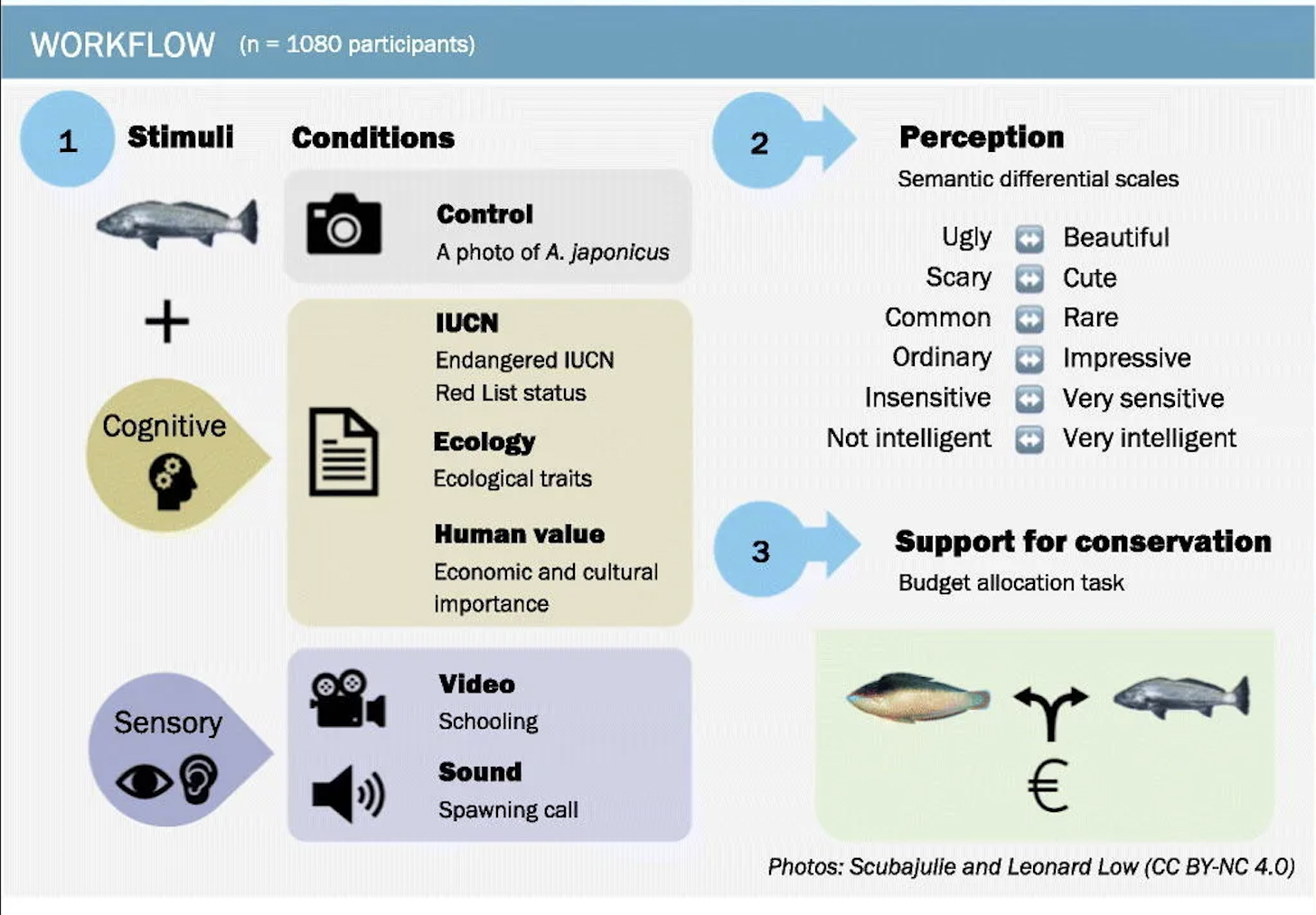
This study investigates how cognitive and sensory stimuli influence public perception and conservation support for the non-charismatic fish Argyrosomus japonicus. A total of 1080 participants in France were randomly assigned to one of six conditions presenting a photograph of the species alone (control), with one of three cognitive stimuli (IUCN Red List status, ecological traits, or economic/cultural value), or with one of two sensory stimuli (video or sound).
Perception was assessed using six semantic differential scales, and conservation support through a hypothetical budget allocation task. Beauty and cuteness were unaffected by any condition, whereas cognitive and sensory stimuli significantly enhanced perceptions of rarity, impressiveness, intelligence, and sensitivity. Auditory stimulus was the most effective treatment and provides, to our knowledge, the first evidence that sound can immediately improve public perceptions of fish.
Although no condition increased conservation support for A. japonicus, cognitive stimuli reduced allocations to a more charismatic species, suggesting they can help mitigate charisma bias. Combining cognitive and sensory pathways, particularly sound, offers a promising strategy to promote overlooked species and strengthen public interest in biodiversity conservation.