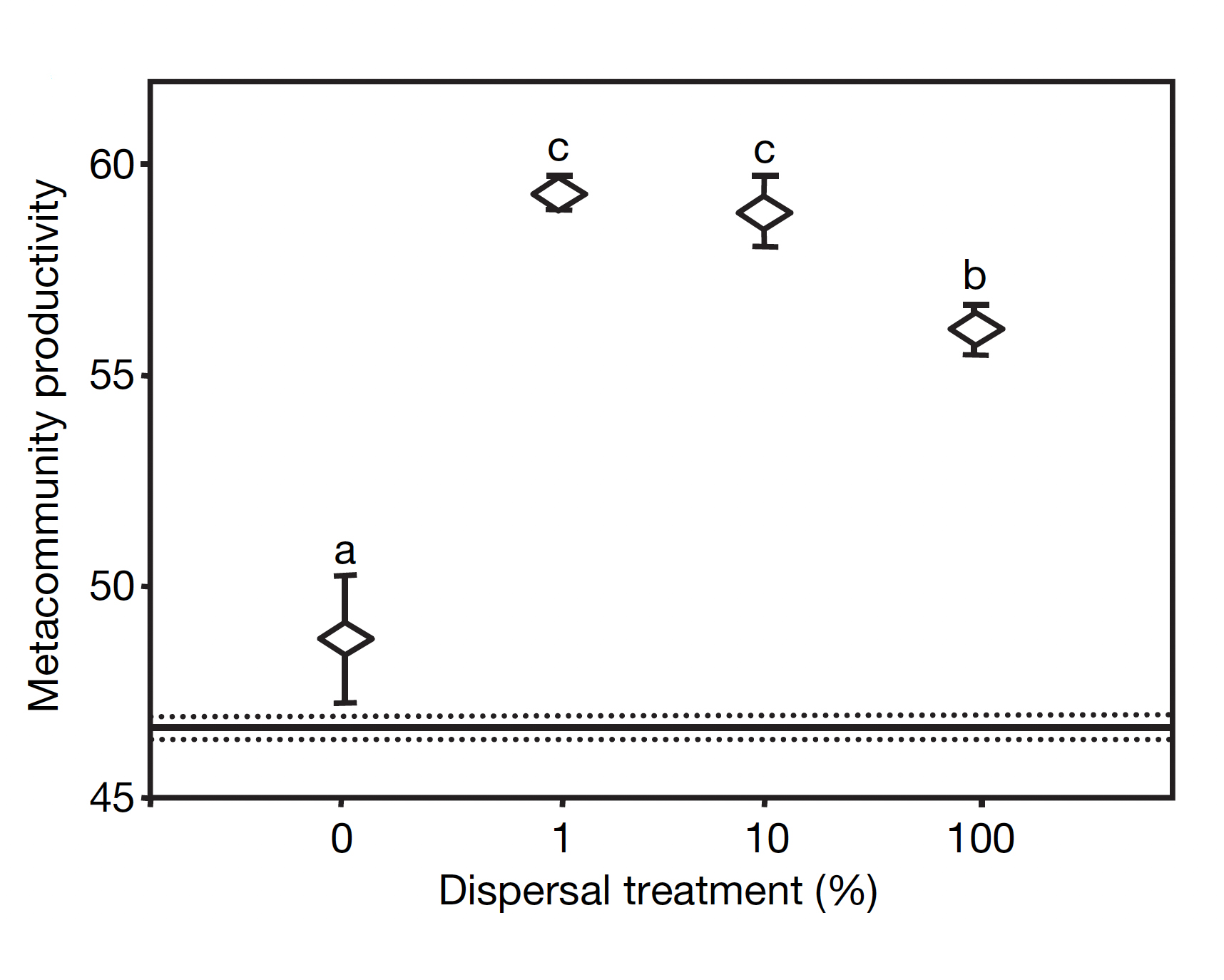
Positive relationships between species diversity and productivity have been reported for a number of ecosystems. Theoretical and experimental studies have attempted to determine the mechanisms that generate this pattern over short timescales, but little attention has been given to the problem of understanding how diversity and productivity are linked over evolutionary timescales.
Here, we investigate the role of dispersal in determining both diversity and productivity over evolutionary timescales, using experimental metacommunities of the bacterium Pseudomonas fluorescens assembled by divergent natural selection. We show that both regional diversity and productivity peak at an intermediate dispersal rate.
Moreover, we demonstrate that these two pat- terns are linked: selection at intermediate rates of dispersal leads to high niche differentiation between genotypes, allowing greater coverage of the heterogeneous environment and a higher regional productivity. We argue that processes that operate over both eco- logical and evolutionary timescales should be jointly considered when attempting to understand the emergence of ecosystem-level properties such as diversity-"function relationships.