Journal of Evolutionary Biology · 2011

Diversification in temporally heterogeneous environments: effect of the grain in experimental bacterial populations

Venail P., Kaltz O., Olivieri I., Pommier T., Mouquet N.

doi.org/10.1111/j.1420-9101.2011.02376.x
Download PDF
Scroll down for preview

Key Message

Although theory established the necessary conditions for diversification in temporally heterogeneous environments, empirical evidence remains controversial. One possible explanation is the difficulty of designing experiments including the relevant range of temporal grains and the appropriate environmental trade-offs.

Here, we experimentally explore the impact of the grain on the diversification of the bacterium Pseudomonas fluorescens SBW25 in a temporally fluctuating environment by including 20 different pairs of environments and four temporal grains. In general, higher levels of diversity were observed at intermediate temporal grains. This resulted in part from the enhanced capacity of disruptive selection to generate negative genotypic correlations in performance at intermediate grains.

However, the evolution of reciprocal specialization was an uncommon outcome. Although the temporal heterogeneity is in theory less powerful than the spatial heterogeneity to generate and maintain the diversity, our results show that diversification under temporal heterogeneity is possible provided appropriate environmental grains.
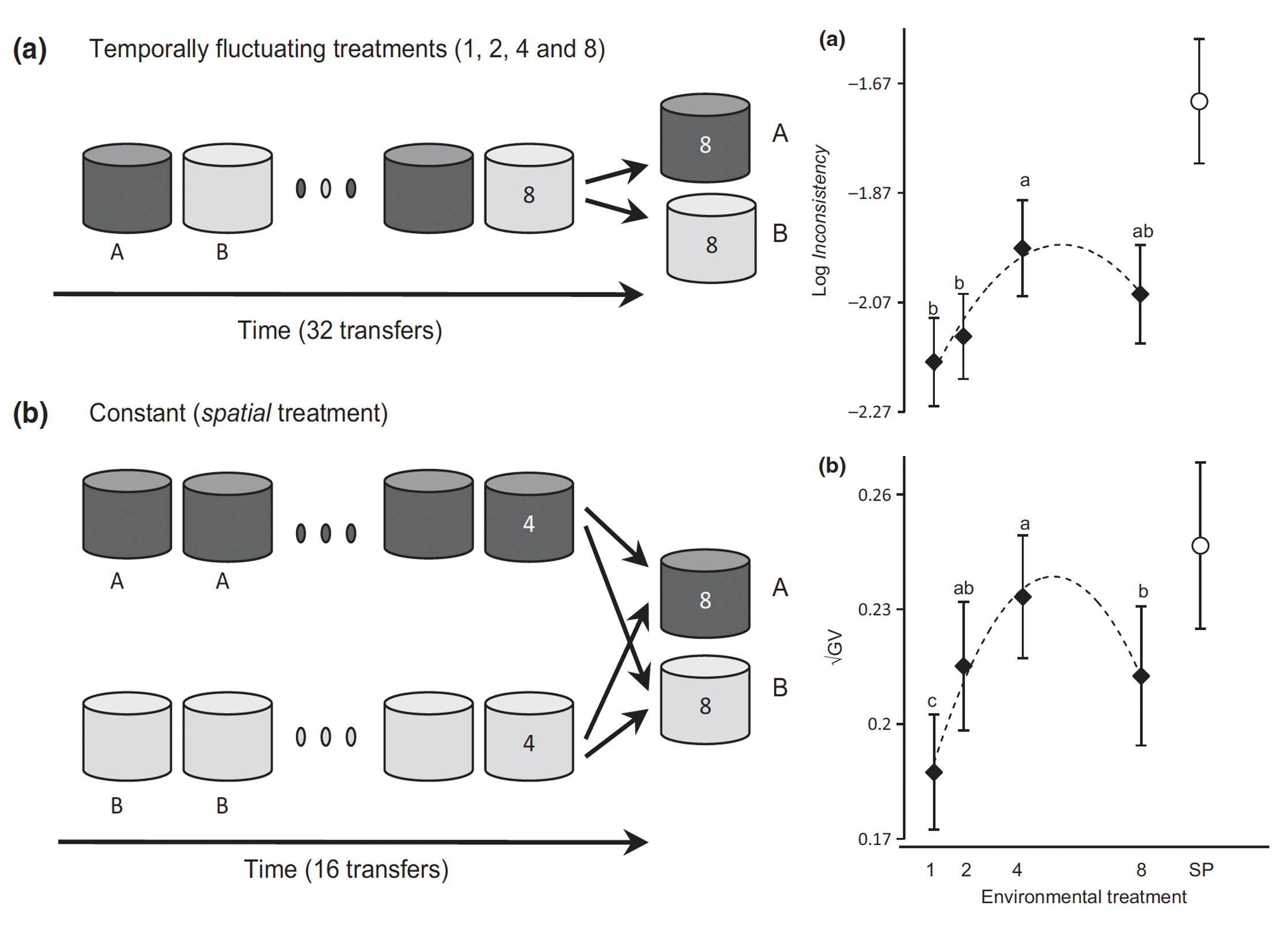
Figure from Venail et al. 2011
Left: Experimental design for calculating genotypic diversity, inconsistency, and genotypic variance (GV). After 32 transfers, eight genotypes from each temporally fluctuating treatment (1-, 2-, 4-, and 8-day) were sampled and assayed on two environmental sources. For the spatial treatment, four genotypes from each constant environment were pooled after 16 days to represent a spatially divided population and a theoretical upper limit of diversification. Right: Effect of temporal environmental grain on genotypic diversity. Mixing genotypes from two selection lines (spatial treatment, open circle) produced the highest inconsistency and genotypic variance. Among temporal treatments, the intermediate 4-day grain showed greater inconsistency than finer grains (1- and 2-day), while genotypic variance peaked at an intermediate temporal grain of about 5 days.
Full Article (PDF)