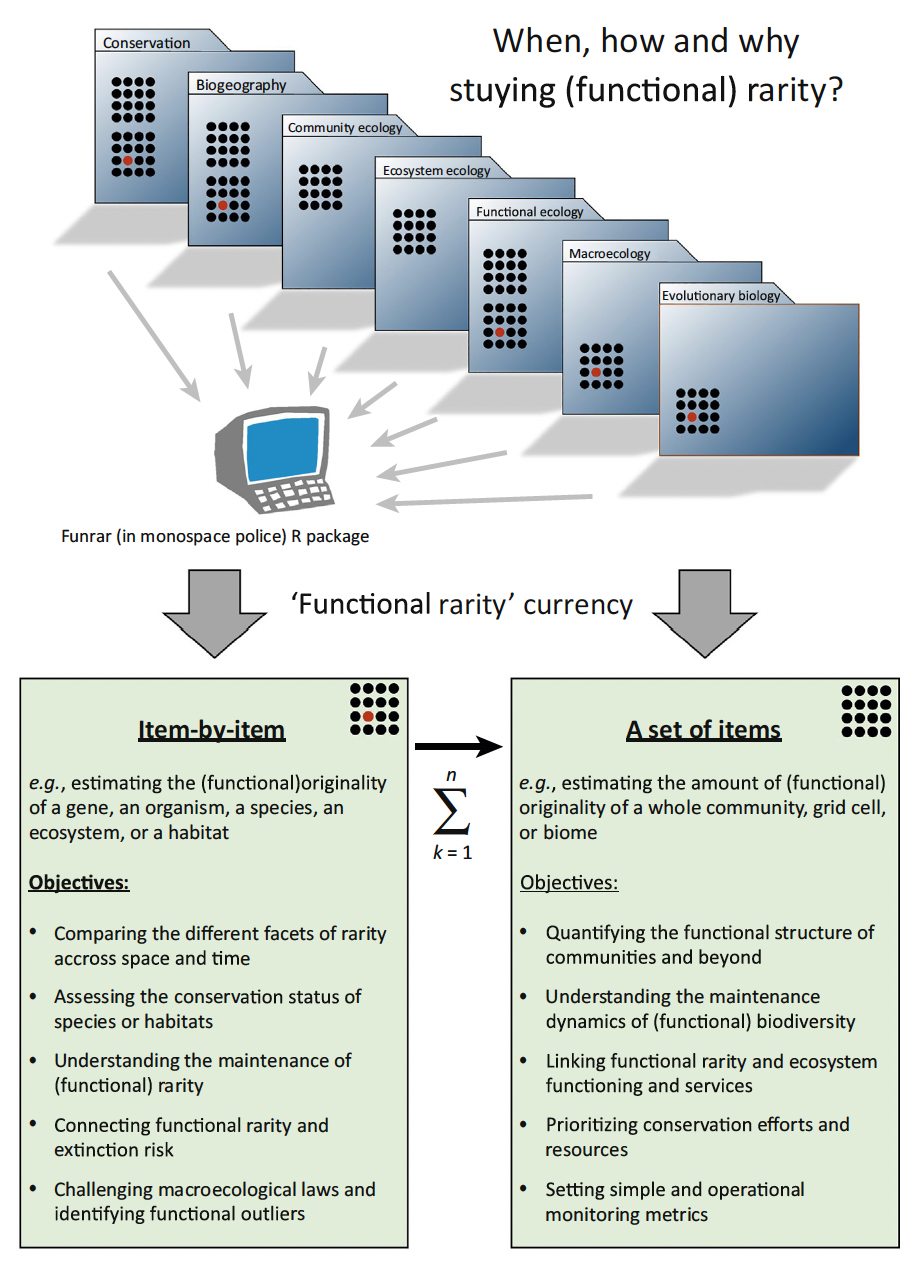
Carmona et al. (2017) respond to our framework on functional rarity (Violle et al. 2017) by advocating for a more general, flexible, and fully quantitative approach, arguing that the use of predefined categories (such as the 12 forms of rarity) and scale-dependent metrics may limit comparability and complicate analyses.
They propose instead a continuous, probabilistic framework based on trait probability density (TPD), which allows rarity to be measured consistently across species, communities, and regions, and better integrates abundance and trait variability across scales. In our response, we acknowledge the value of this probabilistic perspective and agree on the need for a unified toolbox to study rarity across ecological contexts. However, we emphasize that our original framework already relies on continuous indices and that categorization is not opposed to quantification but rather complements it.
We argue that distinguishing forms of rarity remains essential, particularly for conservation purposes, where clear and operational categories can facilitate interpretation, communication, and decision-making. More broadly, we advocate for a pragmatic balance between methodological sophistication and usability, ensuring that advances in the quantification of functional rarity remain accessible and relevant for biodiversity monitoring and management.