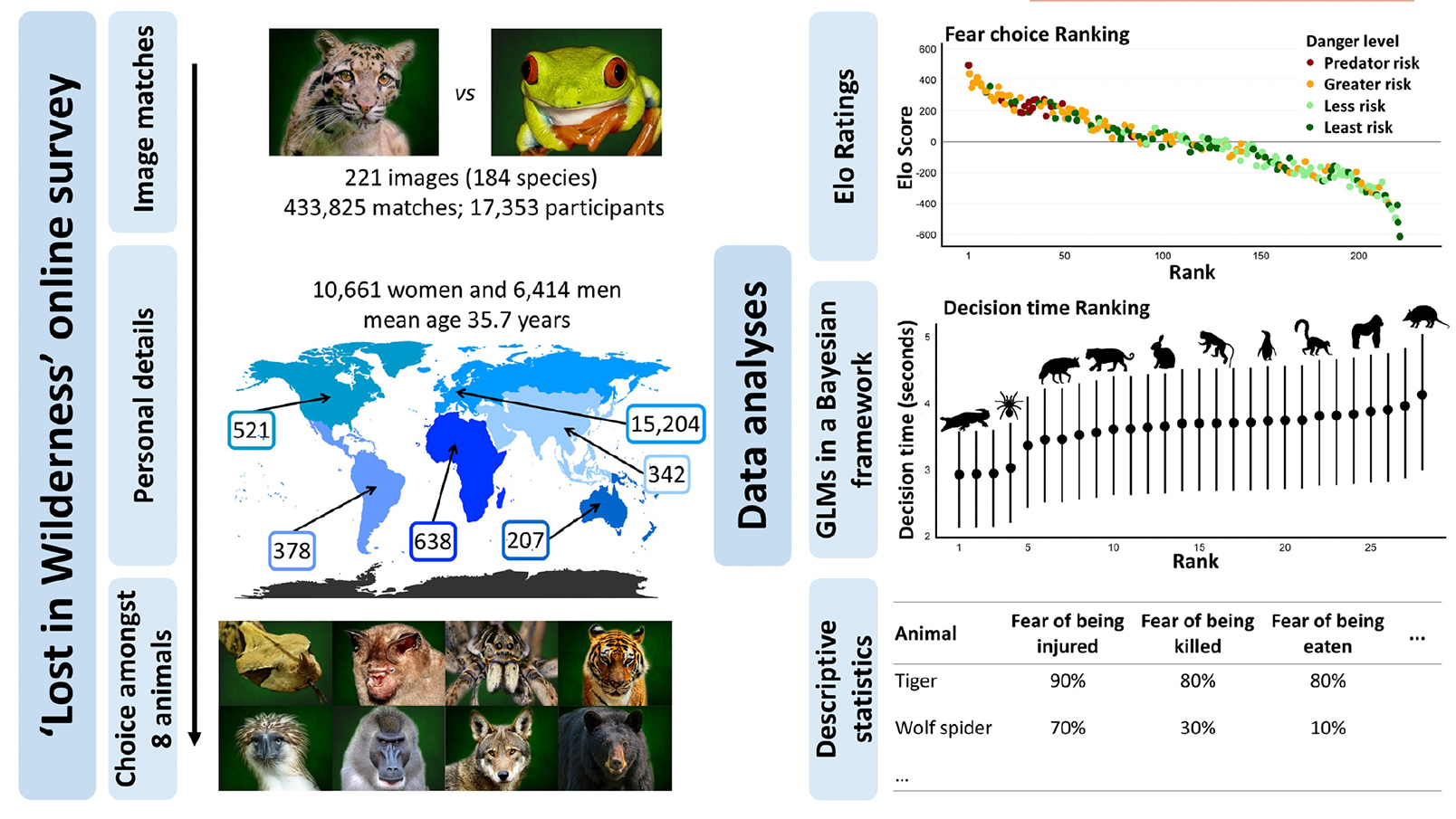
We developed an immersive online survey based on animal images matches, during which participants had to choose the animal they feared most. With responses from 17,353 participants from all continents, we were able to rank 184 species (mammals, reptiles, birds, arthropods and amphibians) on a fear scale.
Our results showed that images of dangerous animals elicited frequent and rapid fear responses. However, danger alone was not sufficient to explain fear, as harmless animals also reached high fear scores. Fear responses varied with participants' age, geographical region of residence and level of declared biophobia.
The discrepancy between actual levels of danger and declared fears in humans may be due to social transmission and increasing disconnection from natural environments. This study highlights the need to consider a wide range of animal species to identify and understand people's fear of certain species, integrating the complex relationship between ecological danger and socio-cultural influences.